Step 4: Settings
Scoring function, how hard to search, how many poses to keep, and how much of the machine to use.
Step 4 in ligand docking is where you trade time against thoroughness. Every field has a default, so the step is never incomplete and its chip reads defaults until you change something.
Settings opens the Docking Settings dialog.
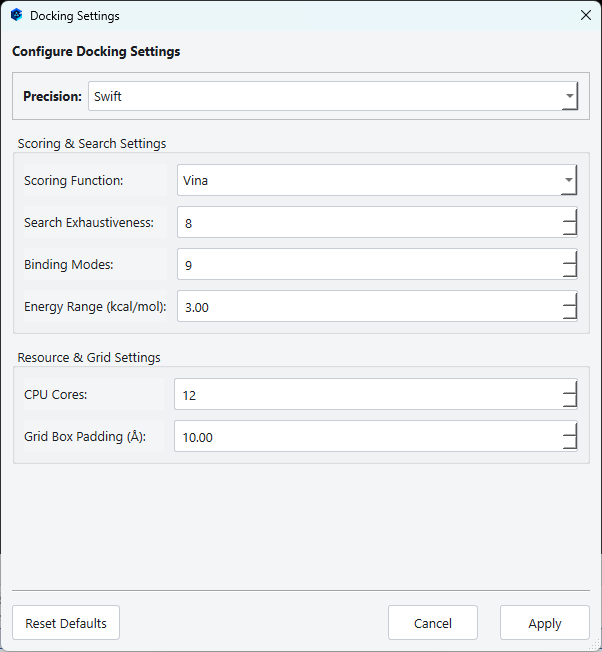
Precision presets
The banner at the top offers three presets. Choosing one sets exhaustiveness, the number of binding modes, the energy range and the box padding together, which keeps them in a sensible relationship to one another.
| Preset | Exhaustiveness | Binding modes | Energy range | Padding | Use it for |
|---|---|---|---|---|---|
| Swift | 8 | 9 | 3.0 kcal/mol | 10 Å | The default. Screening a library, or a first look at a new target. |
| Precise | 16 | 15 | 4.0 kcal/mol | 12 Å | The compounds that survived a screen, where you want a more reliable ranking. |
| Rigorous | 32 | 20 | 5.0 kcal/mol | 15 Å | A small number of important compounds, or anything going into a report. |
Scoring and search settings
Scoring Function
| Option | What it is |
|---|---|
| Vina | The default. An empirical function with a good balance of speed and accuracy across a wide range of targets, and the one to use unless you have a reason not to. |
| Vinardo | A reparameterised alternative with a simpler term set. It performs better than the default on some targets and worse on others, so it is worth trying when you have known actives to test against. |
| AD4 | An established force field based function that uses precomputed affinity maps. Slower, but long standing and well characterised, and a useful second opinion when a ranking looks doubtful. |
Search Exhaustiveness
How hard the search tries, on a scale from 1 to 64, default 8. The search is stochastic, so exhaustiveness is essentially how many independent attempts it makes before reporting the best of them. Doubling it roughly doubles the run time and reduces the chance of missing the best pose.
Below about 8 the results become unreliable from run to run. Between 16 and 32 they become reproducible for most drug sized ligands. Above 32 the returns diminish sharply, and effort is better spent on a better receptor or a tighter box.
Binding Modes
How many distinct poses to report, from 1 to 20, default 9. This does not make the search better; it decides how much of what the search found is kept. Nine is enough to see whether the top poses agree with one another, which is itself a useful signal: several similar poses at similar scores is a more convincing result than one good score surrounded by unrelated alternatives.
Energy Range
The largest score difference, in kcal/mol, between the best pose and the worst one reported, from 0.5 to 10.0, default 3.0. It works with the mode count: you get at most that many modes, and only those within this window of the best. Widening it returns more diverse poses, including weaker ones; narrowing it keeps only the closest competitors.
Resource and grid settings
CPU Cores
How many cores the search may use. The range runs from 1 to however many the machine has, and the default is all of them. The search parallelises well, so this is close to a linear speed up. Reduce it if you want to keep the machine usable for other work while a long batch runs.
Grid Box Padding
Extra space added around the binding site, from 1 to 20 Å, default 10 Å. This applies where the box is derived rather than set by hand, and it is the margin that lets a docked compound extend beyond the exact footprint of the reference ligand. Larger padding means a larger search space and a slower run.
Reset Defaults
Restores the Swift preset: the default scoring function, exhaustiveness 8, nine modes, a 3.0 kcal/mol energy range, all cores and 10 Å of padding. Useful when you have been experimenting and want a known starting point.
What is not here, and why
The three specialised docking modes have no settings page at all. Step 4 becomes their picker instead. This is deliberate: each of those protocols derives its own search parameters from the method it implements, and those derivations are part of what makes the protocol valid. Exposing them as adjustable fields would let a run be quietly invalidated by a change that looked harmless. The dialogs for those modes show you the derived values, and the log records them, so nothing is hidden; it simply is not adjustable.