Covalent docking
Anchoring a ligand to the residue it bonds to: the two ways in, which residues can carry an attachment, and how to check that the geometry makes sense.
A covalent inhibitor does not simply sit in a pocket. It forms a chemical bond to a residue side chain, and after that it is not going anywhere. Docking it as though it were a reversible binder scores the wrong thing entirely: it asks how well the compound fits when the answer that matters is what geometry the adduct adopts once the bond exists. Covalent docking anchors the ligand to the residue it reacts with and searches only what remains free.
Select Docking › Docking Mode › Covalent Docking. Step 4 becomes Covalent Attachment.
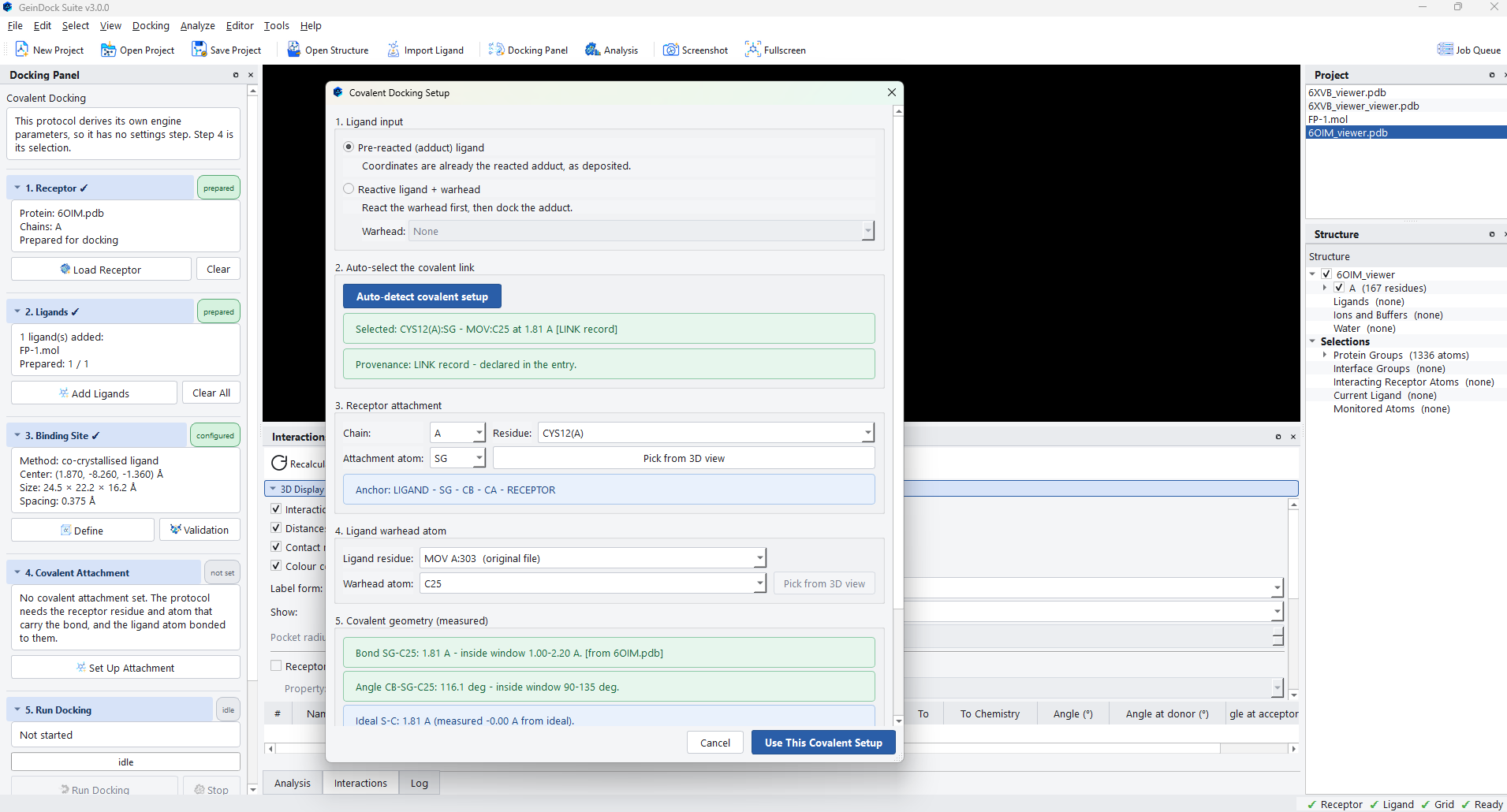
Two ways in, and why they are separate
| Path | What your ligand is | What the software does |
|---|---|---|
| Pre-reacted (adduct) ligand | Coordinates that are already the reacted product, as they would be deposited in a crystal structure: the ring already opened, the double bond already added across. | Models no chemistry at all. The bond length and angle are inherited from your input geometry and then verified rather than sampled. |
| Reactive ligand + warhead | The unreacted compound as you would draw it, with its warhead intact. | Recognises the warhead, removes the leaving group, forms the bond at ideal geometry, and then runs the first path unchanged on the adduct it built. |
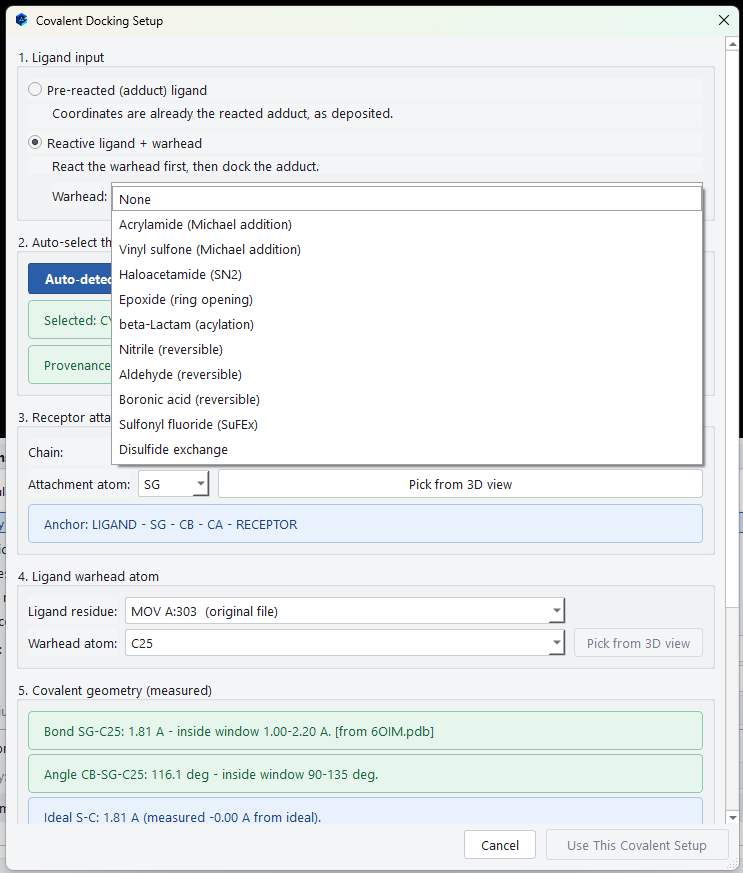
Recognised warheads
The reactive path recognises the chemistries below. Each names the bond formed, what leaves, and the geometry restored.
| Warhead | Reaction |
|---|---|
| Acrylamide | Michael addition. Nothing leaves. |
| Vinyl sulfone | Michael addition. |
| Haloacetamide | Nucleophilic substitution. The halogen leaves. |
| Epoxide | Ring opening. The ring oxygen is retained as an alkoxide. |
| beta-Lactam | Acylation. The ring opens at the nitrogen. |
| Nitrile | Reversible addition. |
| Aldehyde | Reversible hemiketal or hemithioketal formation. |
| Boronic acid | Reversible boronate formation. One hydroxyl leaves. |
| Sulfonyl fluoride | Sulfur fluoride exchange. The fluoride leaves. |
| Disulfide exchange | Thiol disulfide exchange. One half leaves. |
Setting up the attachment
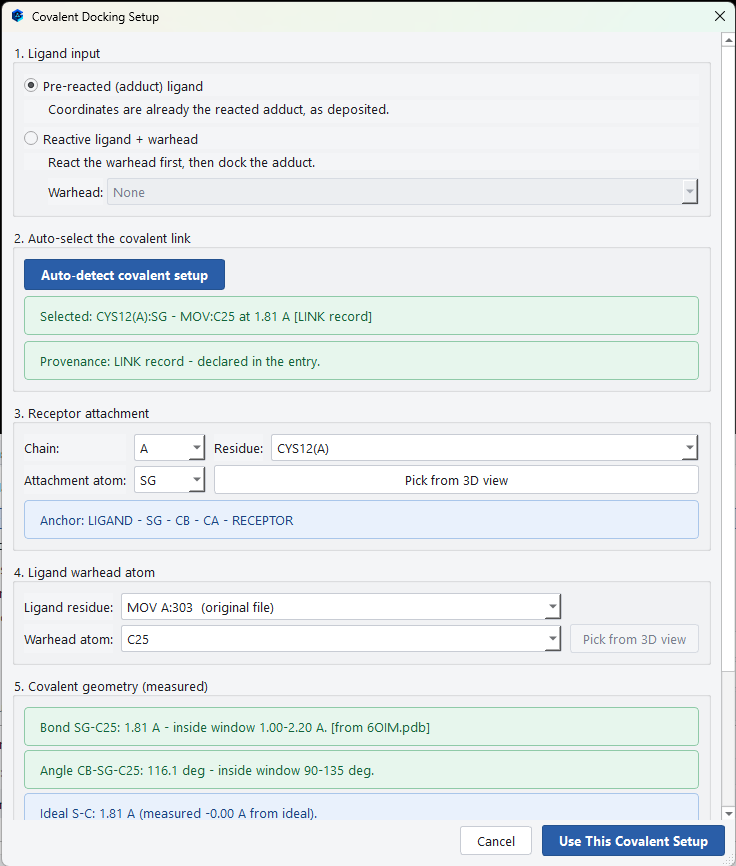
Automatic detection
Auto-detect covalent setup is the place to start. It looks for an explicit link record in the structure file, and failing that searches for a heavy atom pair at covalent bonding distance between a nucleophilic side chain atom and a ligand atom. When it finds one it fills in every field below and reports its provenance, which is recorded with the run.
| Provenance | What it means |
|---|---|
| LINK record | The structure file declares the bond explicitly. This is the strongest evidence there is, because the depositor asserted it. |
| Distance search | No declaration existed, so a nucleophile and a ligand atom were found at bonding distance. Check the pair before you rely on it. |
| Formed | The reactive path built the bond from the warhead you declared. |
The receptor end
Chain, Residue and Attachment atom name the side chain atom that carries the bond, with a Pick from 3D view option if you would rather click it in the viewer. The dialog then reports the anchor it will use, written from the ligand through the side chain to the backbone, so you can see exactly which atoms will be treated as movable.
Eight residues can anchor a covalent attachment.
| Residue | Attachment atom | Typical chemistry |
|---|---|---|
| Cysteine | SG | By far the most common. Acrylamides, haloacetamides, disulfides. |
| Serine | OG | Acylation, notably by beta-lactams and by sulfonyl fluorides. |
| Threonine | OG1 | Acylation. |
| Lysine | NZ | Aldehydes and activated esters. |
| Tyrosine | OH | Sulfur fluoride exchange. |
| Histidine | NE2 or ND1 | Acylation and alkylation. |
| Aspartate | OD1 or OD2 | Esterification. |
| Glutamate | OE1 or OE2 | Esterification. |
The ligand end
Ligand residue and Warhead atom name the ligand atom that carries the bond, again with a 3D picking option. On the adduct path both are required, because nothing can perceive which atom of a deposited complex carries a bond that is already there. On the reactive path the warhead atom is optional, because the declared chemistry already implies which atom is attacked; set it only to disambiguate a ligand carrying two copies of the same warhead.
The measured geometry
Section 5 reports the bond length and the bond angle it measured, each against the window it has to fall inside, and the ideal length for that element pair. These are a check on the setup rather than settings, and they turn green when they are sound.
| Reading | What to make of it |
|---|---|
| Bond length inside the 1.00 to 2.20 Å window and close to the tabulated ideal | The setup is sound. |
| Bond length outside that window | The two atoms you nominated are not bonded. Either the wrong atoms were chosen, or the structure is not a covalent complex at all. |
| Bond angle outside the 90 to 135 degree window | The attachment geometry is strained. Check that the attachment atom is the right one for this residue. |
Search parameters
Section 6 reports the search parameters the protocol uses and states plainly that they are fixed and are recorded in the run log. They are part of the validated method rather than a preference, for the reason set out in Which mode do I need?
Reading the result
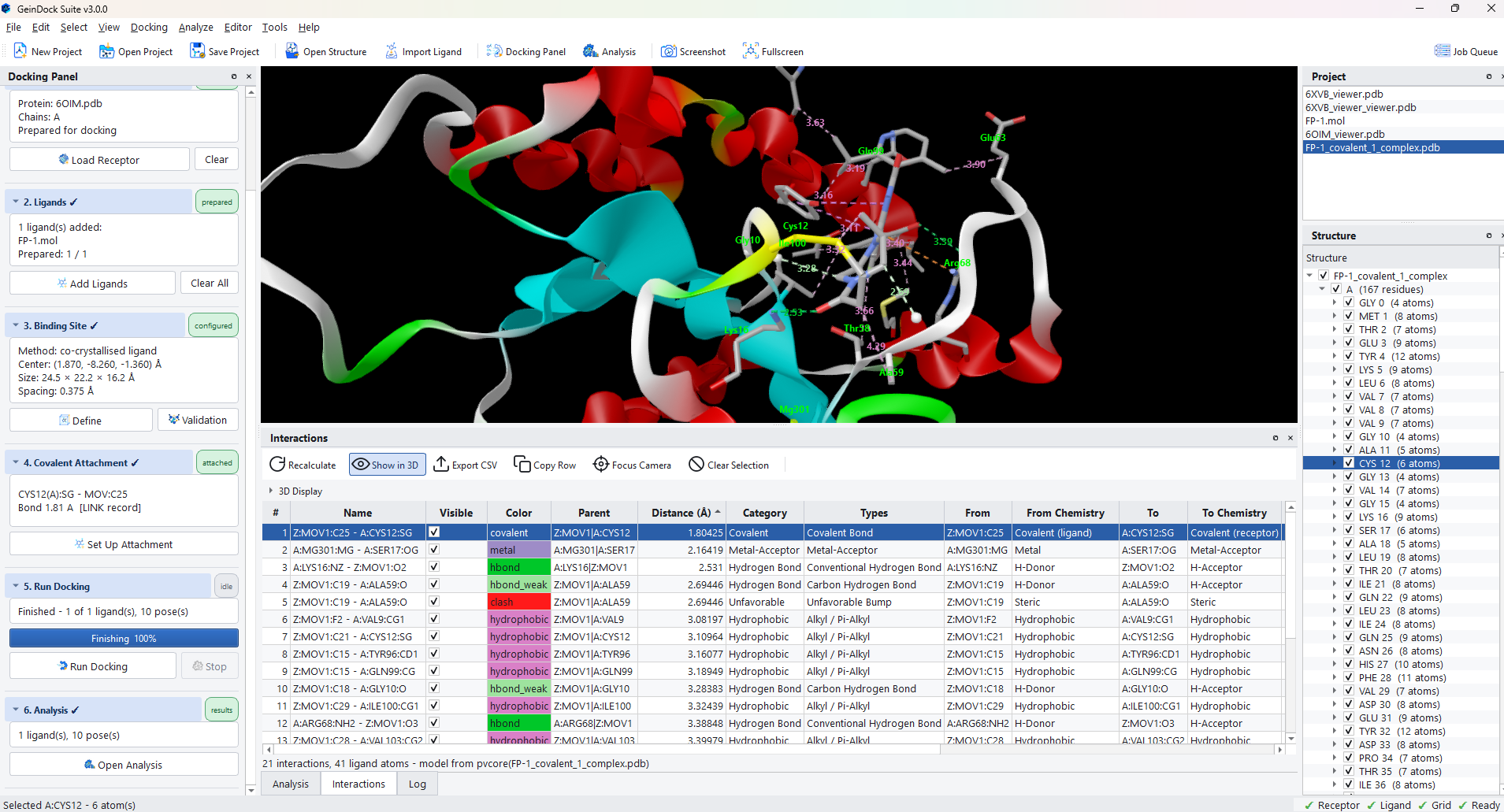
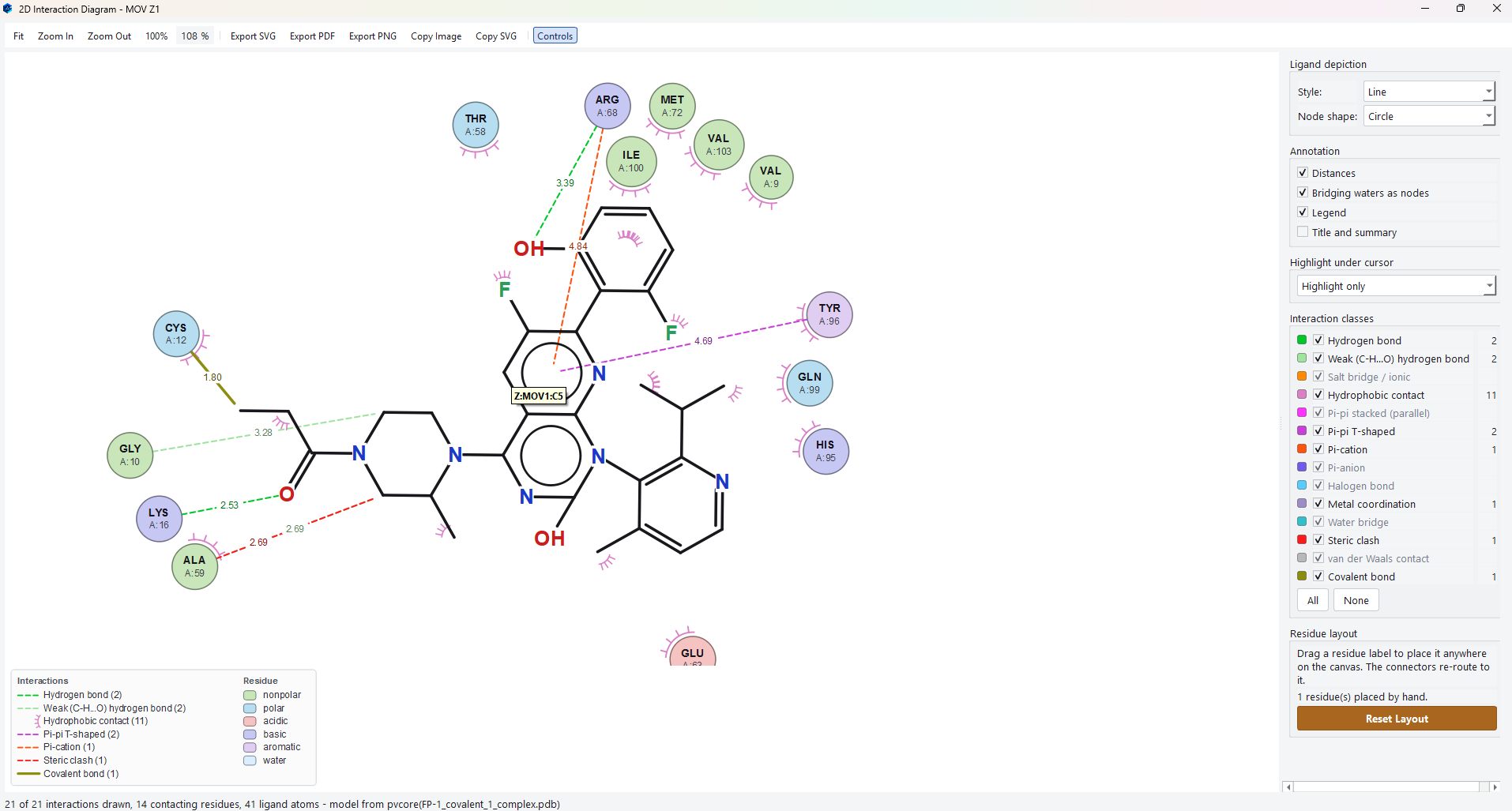
The covalent bond appears in the contact list as a contact in its own right, at the top of the table, with its measured length. Everything else the adduct does appears alongside it.
| Column | What it tells you |
|---|---|
| Cov. bond (Å) | The covalent bond length in the docked pose. |
| Cov. angle (°) | The bond angle at the nucleophile in the docked pose. |
Both are compared against the input geometry, and a pose whose bond has drifted noticeably from where it started is flagged. What varies legitimately in a covalent run is the conformation of the rest of the ligand and of the anchoring side chain; the bond itself should stay put. A pose whose bond has moved a long way is telling you that the search pulled the ligand somewhere the attachment cannot really reach.
A suggested way to work
- Start from a covalent complex if you have one. A deposited structure of a related compound bound to your target gives you a validated attachment and a geometry to check everything else against.
- Let the automatic detection run first. It finds the link, fills in both ends and records how it found it. Correct it by hand only where it is wrong.
- Check section 5 before you run. The measured bond length is the cheapest possible check that you nominated the right pair of atoms.
- Use the reactive path for prospective design. When you are proposing new compounds rather than reproducing known ones, declare the warhead and let the software build the adduct, so that every compound in the series is reacted the same way.