The simulation protocol
The stages every job runs, from structure preparation to the results package, and the physical settings of each, with the reason for every default.
Every job from Run MD or the Batch queue runs the same protocol, the one written into its project file. The defaults below follow common practice for protein-ligand complexes with AMBER ff14SB and GAFF2. Each can be changed on the Run MD page, in the System Builder or in the project file; the tables say when that is worth doing.
The stages of a job
The stage table of the monitor lists the stages under these names, in this order. With one replica a soluble job has fourteen stages.
- "Structure preparation": repair, missing residues, protonation (see Structure preparation).
- "Ligand parameters": GAFF2 types and AM1-BCC charges (see Ligand parameters).
- "Topology": the protein topology and the assembly of the complex.
- "Box, solvent and ions", or "Membrane, solvent and ions" for a membrane job (see Box, solvent, ions and membranes).
- "Run parameters": the parameter files of every simulation stage.
- "Energy minimisation".
- For each replica: "NVT equilibration", "NPT equilibration" (for a membrane job "Equilibration 1 (NVT)" to "Equilibration 6 (NPT)"), "Production", "Trajectory analysis" and "Interaction analysis". With several replicas each name is prefixed "Replica n · ".
- "Statistics and MM-GBSA": statistics over replicas and the binding energy.
- "Detail analyses": the analyses of the report (secondary structure, ligand torsions and properties, PCA and others).
- "Results package": report.pdf, images and raw data (see Exporting results).
All replicas share the system and its minimisation. Each stage hands its exact final state (coordinates, velocities and box) to the next one, and writes a marker when it is complete, so an interrupted job continues where it stopped.
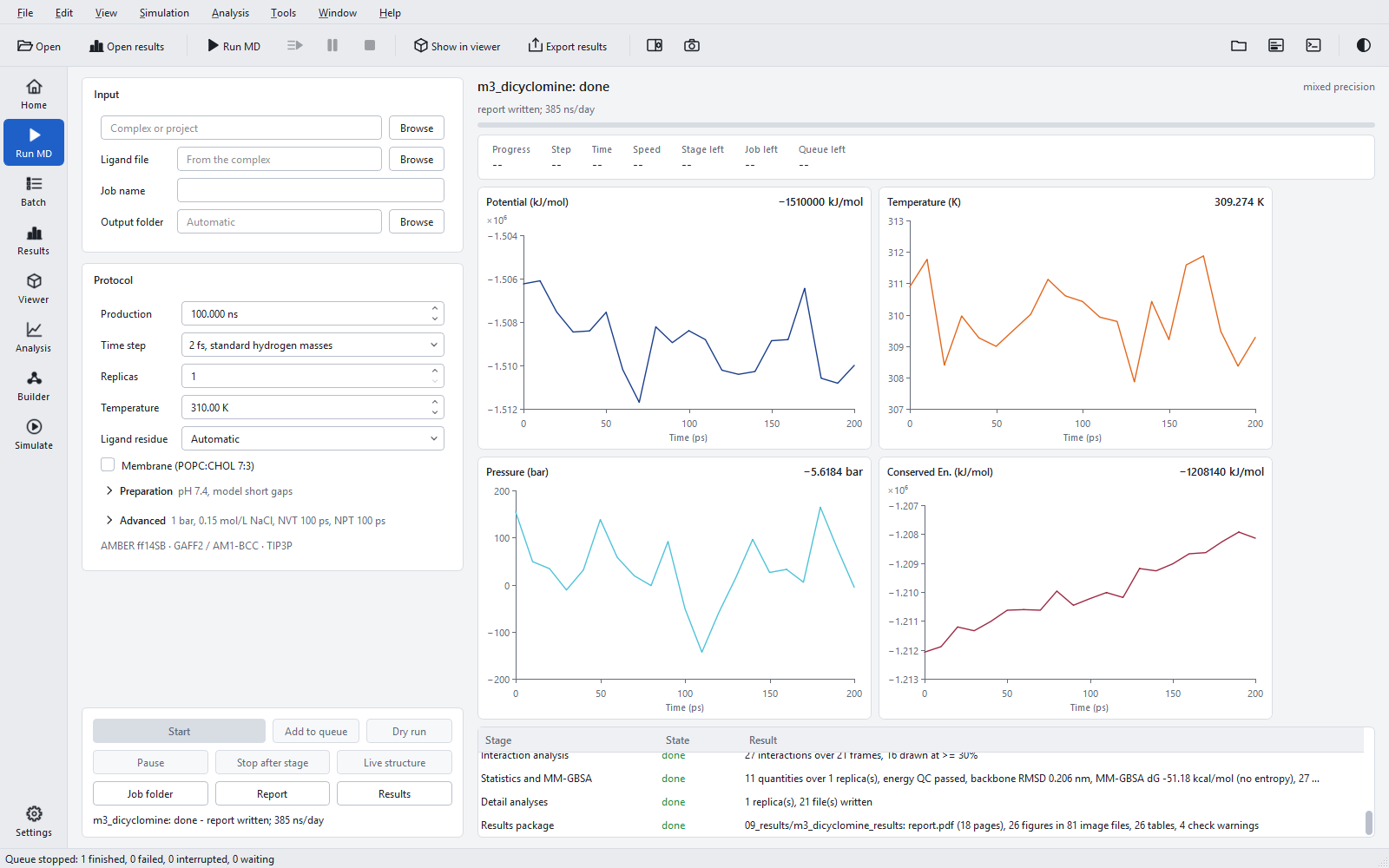
Minimisation
Steepest descent with an initial step of 0.01 nm removes the clashes left by building. It stops when the largest force falls below 1000 kJ/mol/nm or after 50,000 steps. A warning is written if the tolerance was not reached or if the potential energy is still positive afterwards; both point to a structural problem worth a look in the viewer. Minimisation always runs on the CPU engine. It has no checkpoint: if it is interrupted, it starts again from the beginning, which costs little.
Equilibration
Two short restrained stages bring the solvent to the temperature and density of the simulation while the solute is held near its minimised structure:
| Stage | Settings | Why |
|---|---|---|
| "NVT equilibration", 100 ps | Velocities generated at the reference temperature; V-rescale thermostat with separate solute and solvent groups, time constant 0.1 ps; no pressure coupling. | Heats the system without letting the box change while velocities are still far from equilibrium. |
| "NPT equilibration", 100 ps | Continues from the NVT velocities; adds isotropic C-rescale pressure coupling at 1.0 bar, time constant 2.0 ps, compressibility 4.5e-5 bar-1. | Lets the box and the water density settle before production. |
| Both stages | Position restraints on the heavy atoms of the solute, 1000 kJ/mol/nm2, with the minimised structure as reference (reference coordinates scaled with the centre of mass). | Keeps the docked pose and the protein fold intact while the solvent rearranges around them. |
Lengthen either stage ("NVT equilibration", "NPT equilibration" in Advanced) for a large system or one built with many modelled residues, or when the density in the result of the NPT stage still drifts. For membrane jobs both are replaced by the six-stage protocol described in Box, solvent, ions and membranes.
Production
Production runs without restraints, with the same thermostat and barostat, for 100 ns per replica by default. Coordinates are written every 10 ps (10,001 frames for 100 ns), energies and the log every 10 ps, and the full-precision state only at the end. The output intervals can be changed with "More keys" (see The Run MD page).
How long to run depends on the question. A ligand that is unstable in its pose often leaves within tens of nanoseconds; comparing ligands by MM-GBSA and contact occupancy needs enough sampling for the block-averaged error to settle; slow protein motions need much longer than 100 ns, and several replicas help more than one long run.
Interactions between atoms
| Setting | Value | Why |
|---|---|---|
| Electrostatics | PME, grid spacing 0.12 nm, interpolation order 4, Ewald tolerance 1e-5 | Long-range electrostatics without truncation, standard for ff14SB. |
| Cut-offs | 1.0 nm for Coulomb and van der Waals, potential shift | The cut-off ff14SB is commonly used with; the shift removes the jump of the potential at the cut-off. |
| Dispersion correction | For energy and pressure | Corrects the density and pressure for the van der Waals attraction beyond the cut-off. |
| Pair list | Verlet scheme, buffer tolerance 0.005, list update every 10 steps (the GPU engine raises the interval automatically) | The buffer keeps the error from atoms moving between list updates below the tolerance. |
| Centre-of-mass motion | Removed every 100 steps | Prevents the whole system from drifting. |
There is no automatic PME tuning: grid and cut-off are used as set, so runs on different PCs use the same physical model.
Constraints and the time step
Bonds to hydrogen are constrained (LINCS of order 4 for the solute, SETTLE for water). This removes the fastest vibrations and allows a time step of 2 fs.
| Time step | How it is offered | Settings | When to use it |
|---|---|---|---|
| 2 fs, standard hydrogen masses (default) | Run MD, Batch, Builder, project | One LINCS iteration | Every production study. It is the setting the force fields were validated with. |
| 4 fs, hydrogen-mass repartitioning | Run MD, Batch ("4 fs (HMR)"), Builder with "Mass repartitioning", project | Hydrogen masses tripled, the mass taken from the bonded heavy atom; two LINCS iterations in every MD stage | Screening many complexes, or a long run where time to result matters more than identical dynamics. Equilibrium averages are expected to stay the same; dynamical quantities such as diffusion are altered. |
| 1 fs | Project file only, soluble systems only | One LINCS iteration | Tests, or a system that is unstable at 2 fs. |
On the development PC 4 fs gave about 1.8 times the ns/day of 2 fs (see Performance).
Replicas and seeds
A replica is an independent production run from the same equilibrated system with different starting velocities. Replicas show whether a result is reproducible or depends on one trajectory; the statistics tables then give means and standard deviations over replicas. With one replica the standard deviations are over the frames of one trajectory and say nothing about reproducibility.
Replica i uses the velocity seed gen_seed + (i - 1), or the seeds listed in the project file, which must differ. The thermostat and barostat of each stage get their own seeds derived from it. Every job started from the window receives its own gen_seed, at least 100 apart from those of other jobs and from the project default 20261005, so two jobs of the same complex are independent. A job started again in the same folder keeps its seed.
| Setting | Default | When to change it |
|---|---|---|
| "Replicas" on Run MD and Batch | 1 (1 to 20) | Three or more for any result you intend to publish or compare between ligands. |
| "Replicas" on the Builder and in a project file | 3 | As above. |
Multiple time stepping
"Multiple time stepping" (Advanced, "Long-range every 2nd step") computes the long-range mesh part of the electrostatic forces every second step in production, and the short-range forces every step. Only factor 2 is accepted, and only for production; equilibration is unchanged. It is a different integration scheme, so it is an explicit choice and the report says it was used.
Against normal integration the forces of the first frame differed by 8e-7 to 4e-6 relative and all frames by at most 7.1e-5, with the pressure within 2.7 bar. On the development PC it raised the speed by 6 to 14 % depending on system and time step (see Performance). Use it for long runs where that gain matters; leave it off where results must be comparable with runs made without it.
Concurrent replicas
"Concurrent replicas" runs several replicas of a job at the same time on one GPU. A GPU that is not fully busy with one system then does more work in total; each single run is slower. The results are identical to running the replicas one after the other (12 of 12 output files identical in the test).
| Choice | What happens | When to use it |
|---|---|---|
| "One at a time" (default) | Replicas run one after the other. | Large systems, or a PC with a small GPU. |
| "Automatic" | The GPU engine measures, once per job, how many at a time give the best total speed (at most 4, about one second per candidate; the result is written to pipeline.log). The CPU engine runs one. | Several replicas of a small or medium system. |
| 2, 3, 4 | That many at a time. | When you already know the best number for your PC, for example from mdsim bench -batch N. |
On the development PC two, three and four lysozyme-size runs together gave 1.10, 1.15 and 1.18 times the throughput of one; two runs of a 67,156-atom system gave 1.02. Small systems gain most.
Checkpoints and resuming
Every MD stage writes a checkpoint every 5 minutes and at its end. A power cut or a crash therefore loses at most 5 minutes of an MD stage, and starting the job again continues from the checkpoint with the same result as an uninterrupted run (bit for bit on the GPU engine; see The simulation engine and the GPU). Stages that are complete are skipped.
When a setting is changed and the job is started again in the same folder, only the stages affected are repeated: a longer production reruns production and what follows, a different salt concentration reruns from the box stage on. A finished production cannot be extended from its checkpoint; asking for a longer one reruns production from the equilibrated state.
The membrane protocol
Membrane jobs use a staged equilibration of 8.5 ns per replica with restraints released in six steps, 310 K and semi-isotropic pressure coupling. It is described, with its limits, in Box, solvent, ions and membranes.