Geinium documentation
Molecular dynamics of protein-ligand complexes on a Windows PC: from a docked complex to a simulated, analysed and reported system in one application.
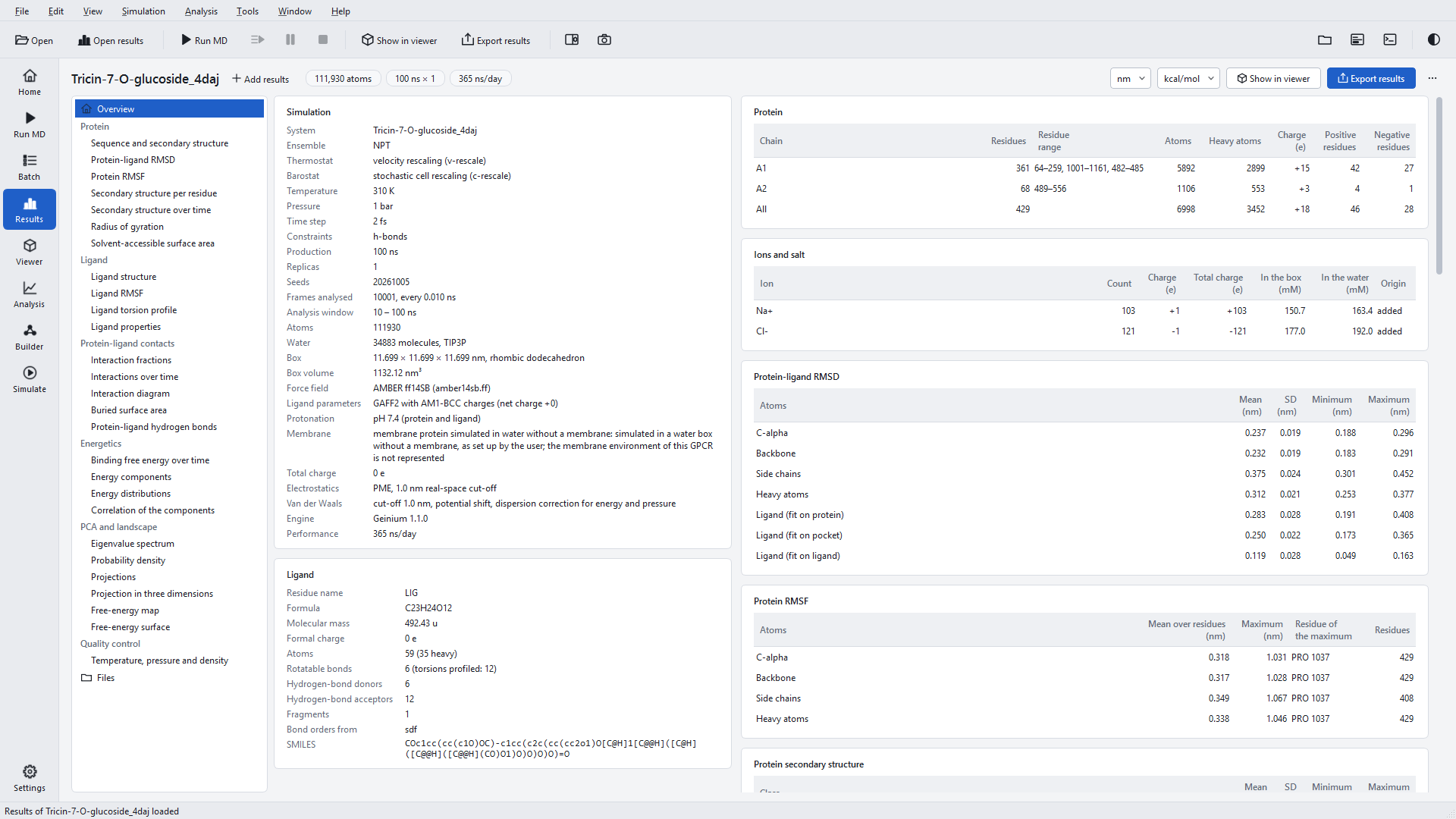
Geinium takes a protein with a docked ligand and returns a simulated, analysed and reported system. It repairs the structure, protonates protein and ligand at the chosen pH, assigns GAFF2 atom types and AM1-BCC charges to the ligand, builds the AMBER ff14SB topology, places the complex in a box of water or in a lipid bilayer with ions, minimises, equilibrates, runs one or more production replicas, analyses the trajectories, computes protein-ligand interactions and an MM-GBSA binding energy, and writes a results package with a PDF report, every figure as an image file and the numbers behind every figure as raw data. No other program takes part at any stage, and nothing has to be installed beside it.
What it does
| Area | What you get |
|---|---|
| Preparation | Repair of missing atoms and alternate conformers, modelling of short missing loops from the sequence, caps at chain breaks, detection of fusion inserts, metal sites and modified residues, and protonation of protein and ligand at a chosen pH. See Structure preparation. |
| Ligand parameters | GAFF2 atom types and AM1-BCC charges computed by Geinium itself, with warnings where a parameter had to be taken by analogy. See Ligand parameters. |
| Systems | A periodic water box (TIP3P, 0.15 mol/L NaCl by default) or, for a membrane protein, a Lipid21 bilayer of POPC and cholesterol with a staged equilibration. See Box, solvent, ions and membranes. |
| Simulation | A GPU engine and a CPU reference engine, chosen automatically. 2 fs with standard hydrogen masses by default; 4 fs with hydrogen-mass repartitioning, multiple time stepping and several replicas are options. Every stage resumes after an interruption. See The simulation protocol. |
| Analyses | RMSD, RMSF, secondary structure, radius of gyration, surfaces, hydrogen bonds and run quality, each with a statistics table. See Trajectory analyses. |
| Interactions | Hydrogen bonds, water bridges, salt bridges, stacking, halogen bonds, metal coordination and hydrophobic contacts with their occupancy, and a two-dimensional interaction diagram. See Protein-ligand interactions. |
| MM-GBSA | A single-trajectory GB-OBC2 binding energy with its components and a block-averaged standard error, for ranking ligands. See Binding free energy (MM-GBSA). |
| PCA and landscape | Principal components of the C-alpha motion and a free-energy landscape over the first two. See PCA and free-energy landscape. |
| Results package | One folder with report.pdf, images at 300 or 600 dpi plus SVG and PDF, raw data as CSV and a manifest with a checksum of every file. Several jobs give one combined report. See Exporting results. |
| Viewer | A molecular viewer with trajectory playback, presets for publication pictures, the binding site and membranes, and image and movie-frame export. See The 3-D viewer and playback. |
Where to start
Two programs, one engine
The installation contains two programs. Geinium.exe is the desktop application with the pages Home, Run MD, Batch, Results, Viewer, Analysis, Builder, Simulate and Settings. mdsim.exe is the command-line program, with about forty commands for preparation, simulation, analysis and reporting; mdsim help lists them and mdsim <command> -h lists the options of one. Both use the same engine, the same data library and the same file layout.
Every job started from Run MD or the Batch queue writes a project file, project.json, into its job folder. Running mdsim pipeline -config project.json on that file reproduces the job without the window, and a job run from a script can be opened on the Results page like any other. The file is described in Project file keys.
Limits worth knowing first
- MM-GBSA ranks ligands bound to the same receptor under the same protocol. It is a single-trajectory estimate without an entropy term and without an implicit membrane, so it is not an absolute binding free energy. See MM-GBSA.
- Free-energy perturbation and other alchemical methods are not offered: no stage of the protocol uses them, and the GPU engine refuses a run input that asks for them. See The simulation engine.
- The GPU engine was run on one graphics card with one driver. The code supports a range of cards; a self test that takes about two seconds tells whether a given PC computes the same forces as the CPU engine. See Installing and starting.
- The staged membrane equilibration is 8.5 ns per replica. That is enough to relax the protein into the bilayer under restraints, but a POPC:cholesterol bilayer needs 200 ns or more of unrestrained equilibration before production analysis. See Box, solvent, ions and membranes.
- A finished production run cannot be extended from its checkpoint. Asking for a longer production reruns production from the equilibrated state. See The simulation protocol.