Structure preparation
What happens to the protein before it is simulated: repair, missing residues, caps, fusion inserts, cofactors, metals and modified residues, and which of these you decide.
Crystal structures and docking receptors are rarely ready to simulate: atoms are missing, loops are unresolved, hydrogens are absent, and residue names vary between programs. The structure stage of every job repairs what can be repaired without a decision, and asks where a decision changes the science. The choices are in the "Preparation" section of Run MD, of the Batch defaults and of the System Builder. Its summary line, for example "pH 7.4, model short gaps", shows the current choices; when the input needs a decision the summary ends in "choice needed" and the section opens itself.
The input is scanned in the background as soon as it is chosen, so the section knows about missing residues, other molecules, metals and modified residues before anything is started. A box at the top of the section shows what the structure stage would stop with, if anything.
What is repaired automatically
| Problem | What is done |
|---|---|
| Alternate conformers | The conformer with the highest mean occupancy is kept, per residue. |
| Missing heavy atoms and side chains | Rebuilt from the residue templates. In the validation, chi1 came within 40 degrees of the crystal value in 79 % of side chains and chi1 and chi2 together in 68 %; the weakest residues were serine (40 %), glutamine (47 %) and arginine (65 %). |
| Residues without backbone N or C | Removed, and the chain is treated as broken at that point. |
| Hydrogens | Hydrogens of protein, water and ions are removed and rebuilt for the chosen pH. Hydrogens of the ligand are kept and checked against the pH (see Protonation at pH). |
| Names | Residue and atom names of other conventions are translated to those of the force field. Selenomethionine (MSE) becomes methionine. |
| Disulfides | Cysteine pairs with SG-SG 0.18 to 0.22 nm are bonded. |
| Crystal waters | Removed. Monatomic ions are kept. |
Missing residues
Residues that the crystal did not resolve leave gaps inside a chain. There are three ways to treat them, chosen with "Missing residues":
| Choice | What happens | When to use it |
|---|---|---|
| "Model short gaps" (default) | Gaps up to "Longest modelled gap" residues (1 to 12, default 8) are built from the sequence and closed; longer gaps are capped. | Most structures. A short loop built and closed keeps the chain continuous, which is closer to the real protein than two loose ends. |
| "Cap breaks" | Nothing is built; both ends of every break get neutral ACE and NME caps. | When the missing loop is long, far from the site, or its conformation would be pure invention. |
| "Charged ends" | Nothing is built; the ends at a break become charged termini. | Not recommended: it creates an artificial ion pair that does not exist in the protein. |
Modelling needs the full sequence. Geinium takes it from, in this order: residues removed for a missing N or C, REMARK 465 records, SEQRES records, a FASTA file named in "Protein sequence", or one-letter codes typed into "Sequence". The two sequence fields appear when the file has chain breaks and no sequence of its own. A sequence is used only when it agrees with the observed residues to at least 90 %. Residues missing at the start or end of a chain are reported but never modelled.
A modelled loop is closed and checked for clashes; it is a plausible conformation, not the native one. In the validation, the backbone RMSD of modelled loops against the crystal loop was about 0.6 angstrom for 2 residues, 0.7 angstrom for 4 and 3.1 angstrom for 8, and modelling took about 1.5, 3 and 20 s per gap. Treat a modelled loop of eight residues as a starting point that equilibration will rearrange, and keep the analysis away from it if it lies near the binding site.
The "Before the start" dialog
Because the choice between modelling and capping changes the system, it is never made silently. When a job has residues missing inside a chain, or a fusion partner, and its structure stage has not yet run, "Start" or "Add to queue" on Run MD and "Start queue" on the Batch page open the "Before the start" dialog first.

| Part of the dialog | What it does |
|---|---|
| "<job>: residues are missing inside the chain:" | Lists each gap with its residue numbers. |
| "Model the missing residues" | Builds gaps up to the longest modelled length from the sequence. The sequence comes "from the file" when it has one; otherwise give a FASTA file ("Browse"), type "or one-letter codes", or press "Get the sequence of <ID> from the PDB". |
| "Get the sequence of <ID> from the PDB" | Downloads the SEQRES records of that entry and saves them as sequences\<ID>.fasta in the settings folder. This is the only network use of the program; it happens only on this click, with a 20 s time-out. |
| "Cap the ends (neutral)" | Builds nothing and caps both ends of every break. |
| "Fusion partner (not part of the native protein):" | Names the insert, for example "T4 lysozyme (cysteine-free, C54T/C97A), A:1001-1161 (161 residues, 99 % identical)", with the choices "Keep" and "Remove (ends capped)". |
| OK, Cancel | Nothing is preselected and OK is enabled only when every question is answered. Cancel does not start the job; the status line reads "Not started: missing residues decision needed". |
The answer is stored with the job and shown in the form, so the question is not asked again. Jobs started from a project file are not asked: the file holds the decision.
Chain ends and caps
Chain termini are charged by default, as in the protein. "Cap chain ends" puts neutral ACE and NME groups on the first and last residue of every chain as well; use it when the chain ends of the construct are artificial (a domain cut out of a larger protein) and a charge there would be misleading. Caps are built in the equilibrium geometry of ff14SB. A single residue isolated between two breaks is removed unless it is capped.
Fusion inserts
Many membrane receptors are crystallised with a soluble protein inserted into a loop to help crystallisation. Geinium compares every segment with a built-in table of six common partners: T4 lysozyme (including its cysteine-free variant), BRIL, PGS, rubredoxin, flavodoxin and MBP. A segment with at least 90 % identity over 80 residues is reported as a fusion partner, and the "Before the start" dialog asks whether to keep it or remove it with the receptor ends capped.
| Choice | Consequence | When to use it |
|---|---|---|
| "Keep" | The insert is simulated with the receptor. Analyses that describe the receptor exclude it (the RMSD and the PCA, for example) and say so. | When the insert holds the loop in the conformation of the crystal and removing it would leave a long gap. |
| "Remove (ends capped)" | The insert is cut out; the two receptor ends get neutral caps. | When you want the receptor alone, and the gap left behind is far from the binding site. |
Cofactors, additives, water and ions
Every molecule besides the protein and the ligand is listed under "Remove molecules", with its name, position and category. Crystallisation additives (SO4, PO4, GOL, EDO, PEG) are marked " - removed anyway". Cofactors, glycans and unknown molecules stop the structure stage until they are ticked for removal, because the force field has no parameters for them. Crystal waters are removed and monatomic ions are kept.
Metal sites
Transition metals and Mg, Ca, Sr and Ba are reported with the N, O and S atoms that coordinate them within 0.28 nm, in a line "Metal sites: ..." of the Preparation section. "Apply suggested states" (in Preparation > Advanced) sets the residue states that fit the site: a deprotonated cysteine (CYM) for a thiolate, and the histidine tautomer whose free nitrogen binds the metal (HID for NE2-bound, HIE for ND1-bound histidine).
Modified residues
| Residues | What happens | Way out |
|---|---|---|
| MLY, CSO, CSD, OCS, CSX, CME, KCX (crystallisation artefacts: methylated lysine, oxidised cysteine) | The job stops. | "Revert crystallisation artefacts" turns them back into the natural residue. Its tooltip lists the residues found. |
| SEP, TPO, PTR, NEP (phosphorylated residues) | The job stops: no parameters are shipped. | None in this version. |
| MLZ, M3L, ALY, CGU | The job stops unless the project file names them. | See Project file keys. |
| MSE (selenomethionine) | Becomes methionine automatically. | Nothing to do. |
Checks reported in the log
Some findings do not stop a job but deserve a look. They are written to the log and to the job: a histidine next to a carboxylate (a doubly protonated HIP may fit better), buried Asp, Glu or Lys residues, and bond lengths more than 25 % away from the expected value.
Residue numbering
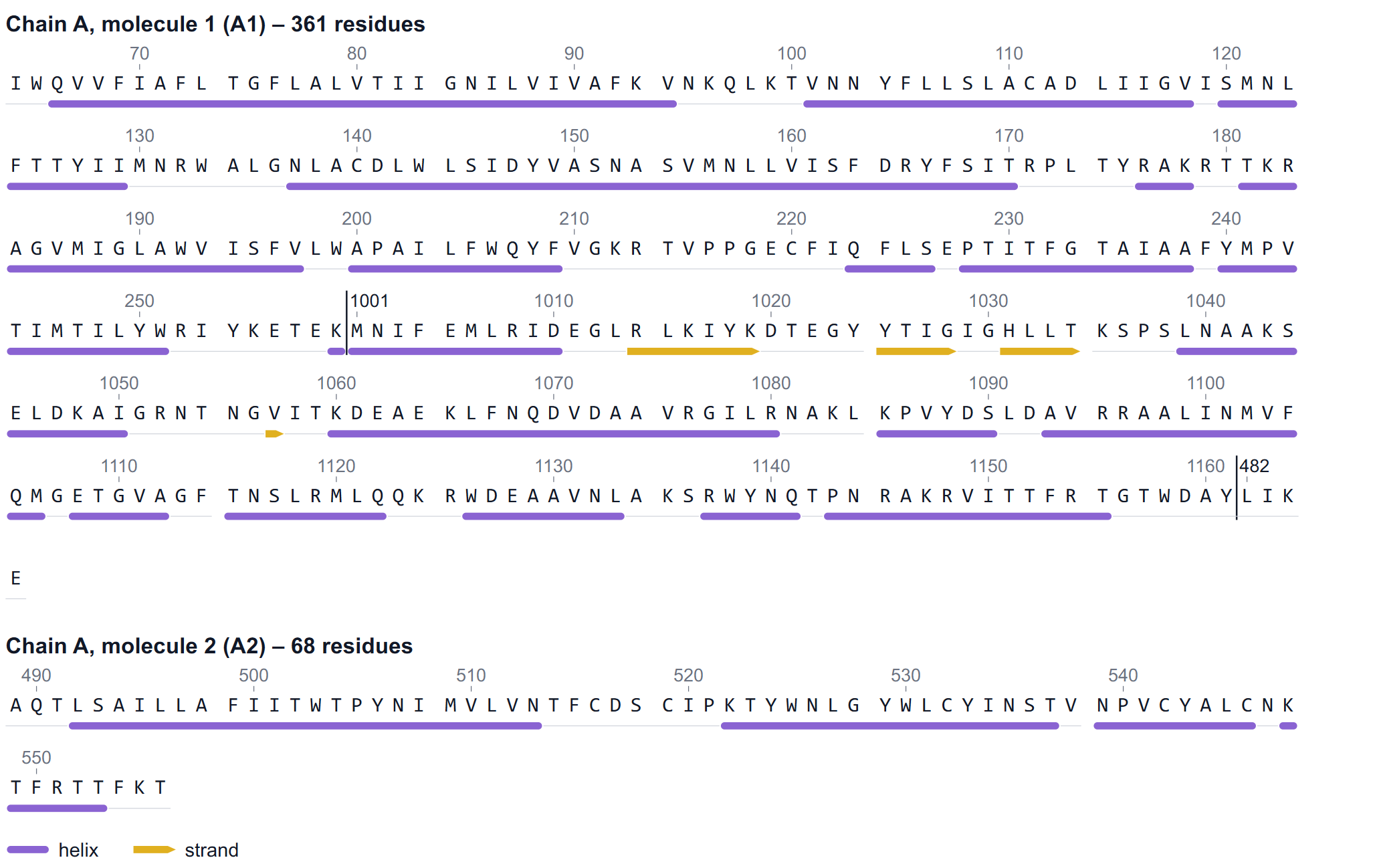
Residue numbers, chain identifiers and insertion codes of the input are kept through the whole job, so residue 107 of chain A in the results is residue 107 of chain A in your file. Where a chain is broken into several molecules, the results name them A1, A2 and so on, and residue axes show the segments with separators and their own numbers, as in the figure above.
Limits
- Nucleic acids and glycans are not repaired.
- D-amino acids are handled only when their CB atom is present.
- Modelled loops are plausible, clash-free conformations, not predictions of the native loop.