Density, spin and derived fields
The electron density itself, the spin density of an open-shell system, and the two fields derived from the density that say where bonds and reactive sites are.
Electron density
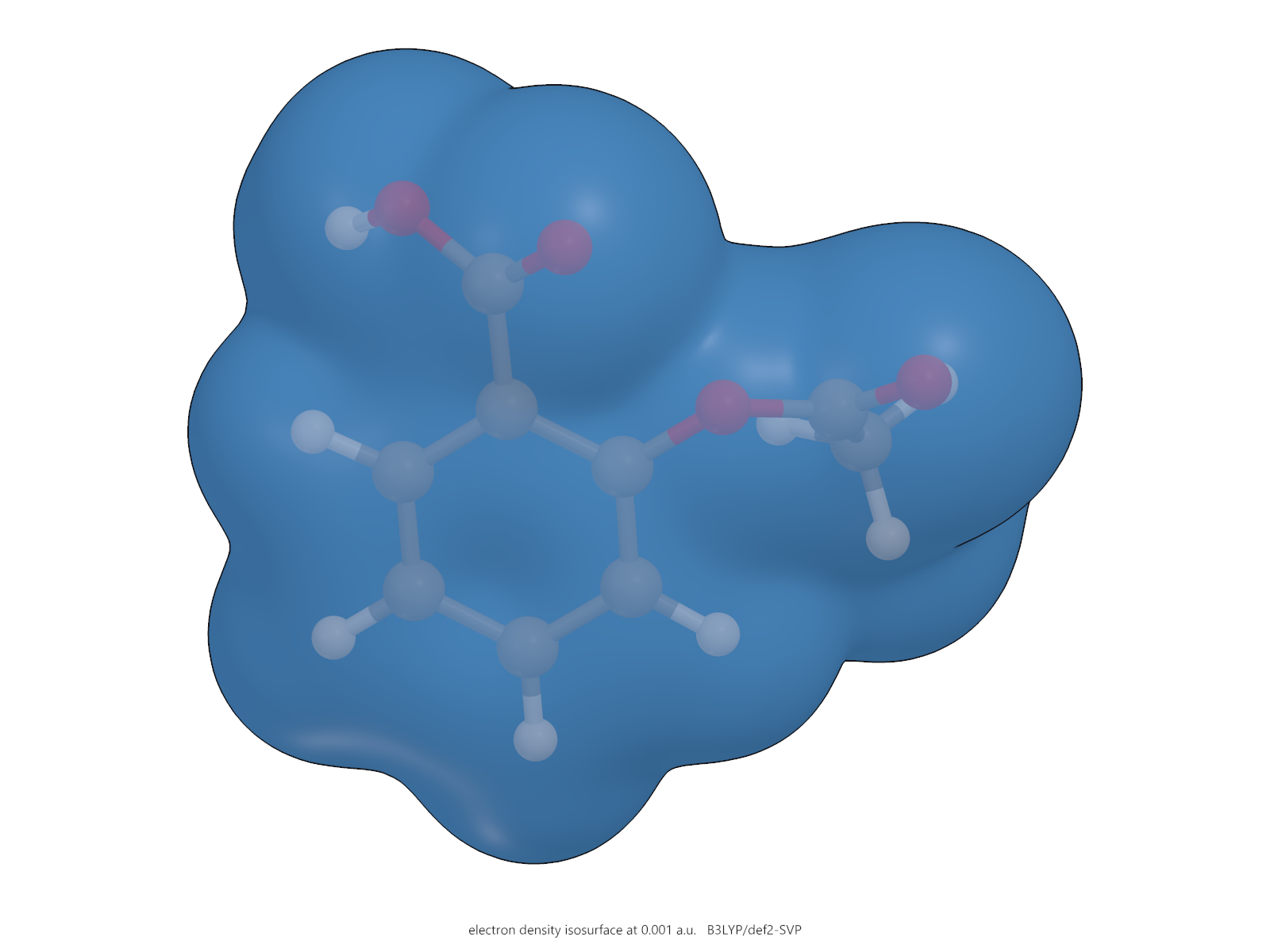
The total electron density is the physical observable behind every other quantity here. Drawn at 0.001 electrons per cubic bohr it gives the molecular surface, which is the shape the molecule presents to its surroundings and the surface other quantities are mapped onto.
| Isovalue | What it shows |
|---|---|
| 0.001 e/bohr3 | The conventional molecular surface, close to the van der Waals contact surface. The standard choice for mapping the electrostatic potential. |
| 0.01 to 0.05 | A tighter surface that follows the bonding framework more closely. |
| 0.2 and above | Only the regions of high density around the nuclei and along the bonds. |
Spin density
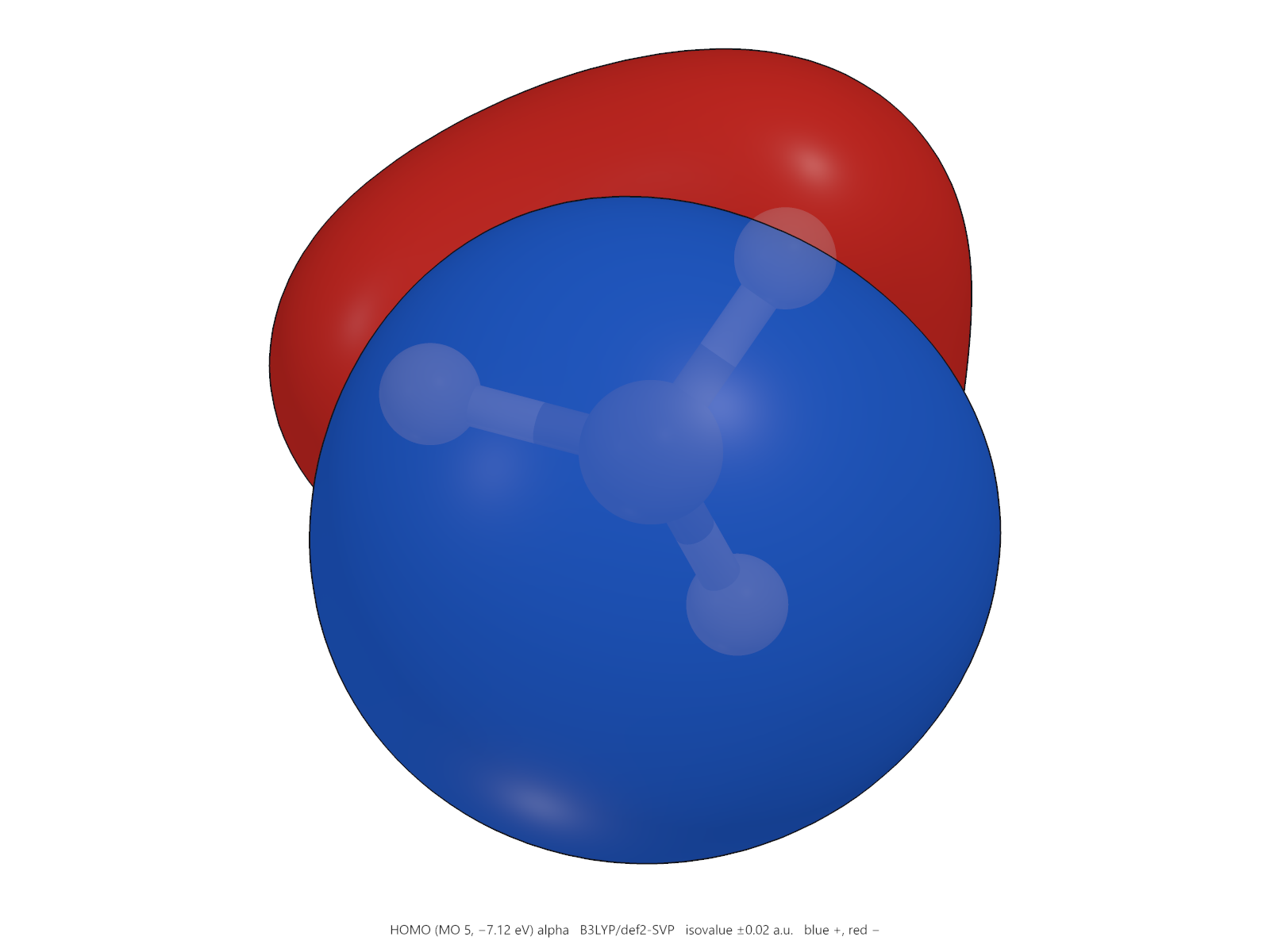
For any system with unpaired electrons, the spin density is the difference between the alpha and beta densities. It answers the question that matters for a radical: where is the unpaired electron? The field is available whenever the calculation was unrestricted, which is to say whenever the multiplicity was greater than one.
Laplacian of the density
The Laplacian is the second derivative of the density: it measures where density is locally concentrated and where it is depleted. Regions of concentration correspond to bonding electron pairs and lone pairs, which makes it a way to see features that the density itself does not resolve. It is available for any finished calculation.
Average local ionisation energy
This field reports, at each point on the surface, how tightly the electrons there are bound. Its minima mark the points most easily ionised, which is to say the sites most susceptible to electrophilic attack. It complements the electrostatic potential: the potential says where a charge is attracted, while the ionisation energy says where electrons are loosely held, and for aromatic substitution the second is often the better guide.
Producing any of them
All of these fields appear in File > Export Cube, which lists what the current result can produce, lets you choose the grid spacing and reports the point count before computing. The field is evaluated on a worker thread with a progress indicator, and the window keeps drawing while it runs.
| Field | Needs |
|---|---|
| Electron density | Any finished calculation. |
| Electrostatic potential | Any finished calculation. |
| Laplacian of the density | Any finished calculation. |
| Average local ionisation energy | Any finished calculation. |
| Spin density | An unrestricted calculation. |
| Molecular orbitals | Any finished calculation; each orbital on demand. |
| Fukui functions | Fukui functions requested in the setup, which costs two extra calculations. |