Home › Reading the results
Reading the results
What the Results tab reports once a calculation has finished, and which numbers are safe to quote from it.
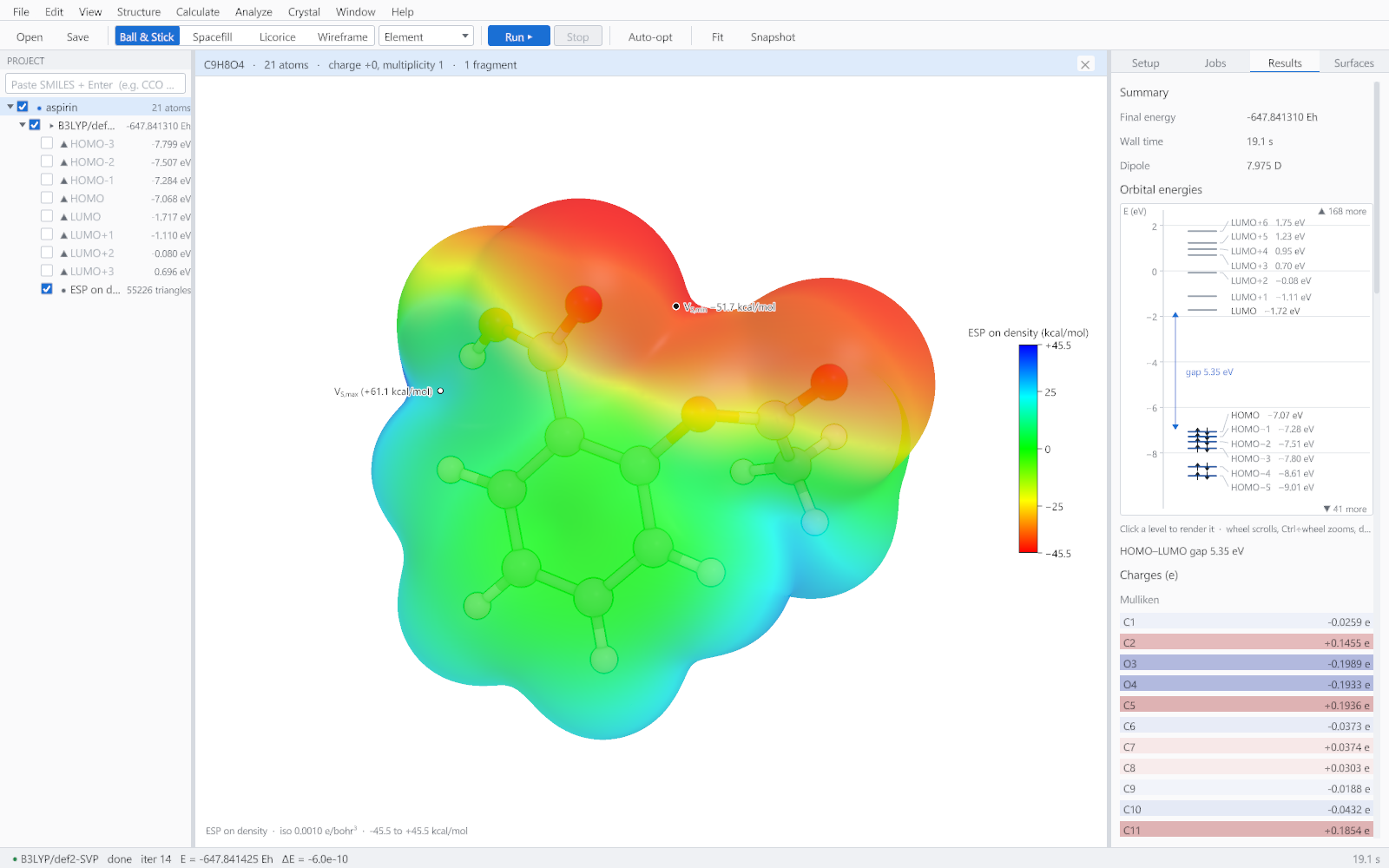
The summary
| Entry | Meaning |
|---|---|
| Final energy | The total electronic energy including nuclear repulsion, in hartree. It is an absolute energy, so it is meaningful only in differences between calculations at the same method and basis set. |
| Wall time | How long the job took from start to finish, including the properties and any volumetric fields. |
| Dipole | The total dipole moment in debye, from the converged density and the nuclear positions. |
Total energies from different basis sets are not comparable, and neither are energies from different functionals. Any energy you report should be a difference between calculations that differ in one thing only.
Orbital energies
The diagram shows the occupied and empty levels on an energy axis in electronvolts, with the gap between the highest occupied and lowest empty orbital marked. Hovering a level gives its energy and occupancy, and clicking it renders that orbital in the viewer. See Orbital energies and orbitals.
Property tables
Below the diagram are the properties that were requested on the Properties tab: the charge analyses, the bond orders and the reactivity descriptors. Every table is also written to a CSV file beside the result, so nothing has to be retyped to get it into a spreadsheet or a plot.
Where the numbers also live
| File | Holds |
|---|---|
<name>.out | The complete human-readable record of the run: the settings, every SCF iteration, the final energy, the orbital list and every property. |
properties_charges.csv | Every charge scheme, one column each, one row per atom. |
properties_dipole.csv | The dipole components and magnitude. |
properties_bond_orders.csv | Bond orders by atom pair. |
properties_frontier_orbitals.csv | Frontier orbital energies and their composition by atom. |
properties_reactivity.csv | The conceptual descriptors derived from the frontier orbitals. |