GeinDFT documentation
A density functional theory engine and molecular visualiser in one application: read a structure, run the calculation, and see the result as a figure you can publish.
GeinDFT computes electronic structure and draws it. It reads a structure in any common format, builds three-dimensional coordinates when the file has none, optimises the geometry, runs a Hartree-Fock or Kohn-Sham calculation, derives the properties a chemist reports, and renders the frontier orbitals and the electrostatic potential at publication quality. No other program takes part in the calculation. GeinDFT is part of GeinDock Suite and runs on the GeinDock Suite licence, so GeinDock Suite has to be installed on the same computer.
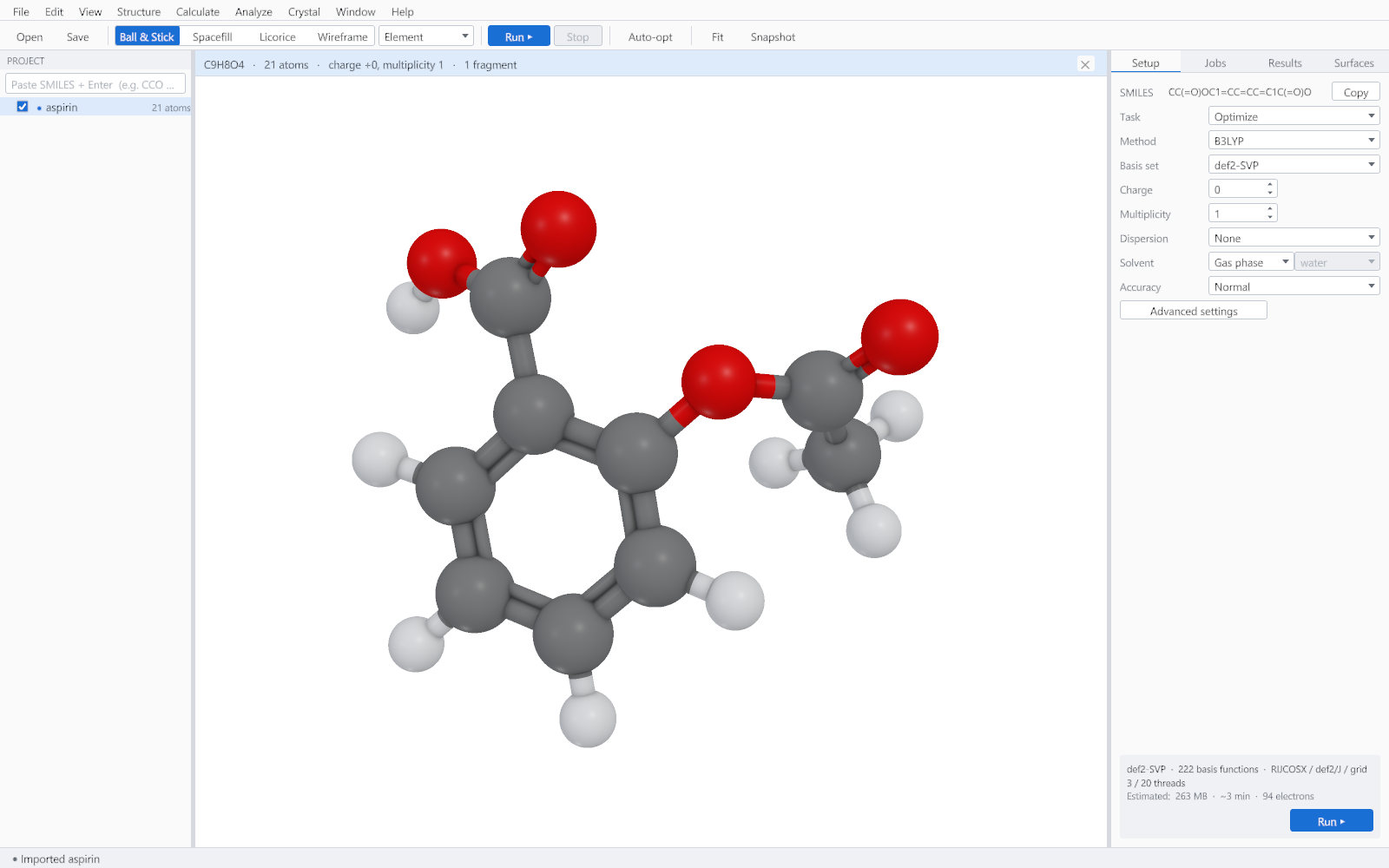
What it computes
| Area | What you get |
|---|---|
| Methods | Hartree-Fock and Kohn-Sham density functional theory, restricted and unrestricted: local, gradient-corrected, meta and hybrid functionals, and range-separated hybrids. |
| Basis sets | The Pople, Ahlrichs def2 and Dunning correlation-consistent families, with effective core potentials for the heavy elements. |
| Tasks | Single-point energies, geometry optimisation, transition-state search, harmonic frequencies and thermochemistry. |
| Properties | Mulliken, Loewdin, Hirshfeld and CHELPG charges, dipole and quadrupole moments, bond orders, orbital composition and reactivity descriptors. |
| Fields | Electron density, the electrostatic potential mapped on the density surface, molecular orbitals, spin density, the density Laplacian, the average local ionisation energy and Fukui functions. |
| Crystals | Unit cell and symmetry handling, packing and cluster generation, Hirshfeld surfaces, fingerprint plots and close-contact analysis. |
Where to start
Two programs, one engine
The desktop application and the command-line program share the same engine, the same settings and the same output files. Anything set up in the window can be saved as a job file and run from a script, and a calculation run from a script can be opened in the window to look at its orbitals and surfaces.