Opening a structure
The file formats the program reads, the three ways to open one, and what happens when a file has no three-dimensional coordinates.
Three ways in
| Route | How |
|---|---|
| File > Open | Or Ctrl+O. The format is detected from the content of the file, not from its extension, so a mis-named file still opens. |
| Drag and drop | Drop one or more files onto the viewer. Each becomes a structure in the project tree. |
| Paste a SMILES string | Type or paste into the box at the top of the project panel and press Enter. See Building from SMILES. |
Formats that can be read
| Format | Notes |
|---|---|
| XYZ | Including extended XYZ and multi-structure trajectory files. |
| MOL and SDF | V2000 and V3000. Bond orders, charges, isotopes and the wedge and hash bonds that carry stereochemistry are all read. |
| PDB and mmCIF | Including the option to drop crystallographic waters. |
| MOL2 | With its atom types and partial charges. |
| CIF | A crystal structure, expanded by its symmetry operations. See Crystal analysis. |
| SMILES | As a .smi file or pasted into the window. |
| Cube | A volumetric field with the geometry it was computed for. |
| External QM input | Input files written for other quantum chemistry programs, including Z-matrix geometries. |
| GeinDFT job and result files | A .gin job file carries a geometry and its settings; a finished .out reopens with its orbitals and surfaces. |
Files with no three-dimensional coordinates
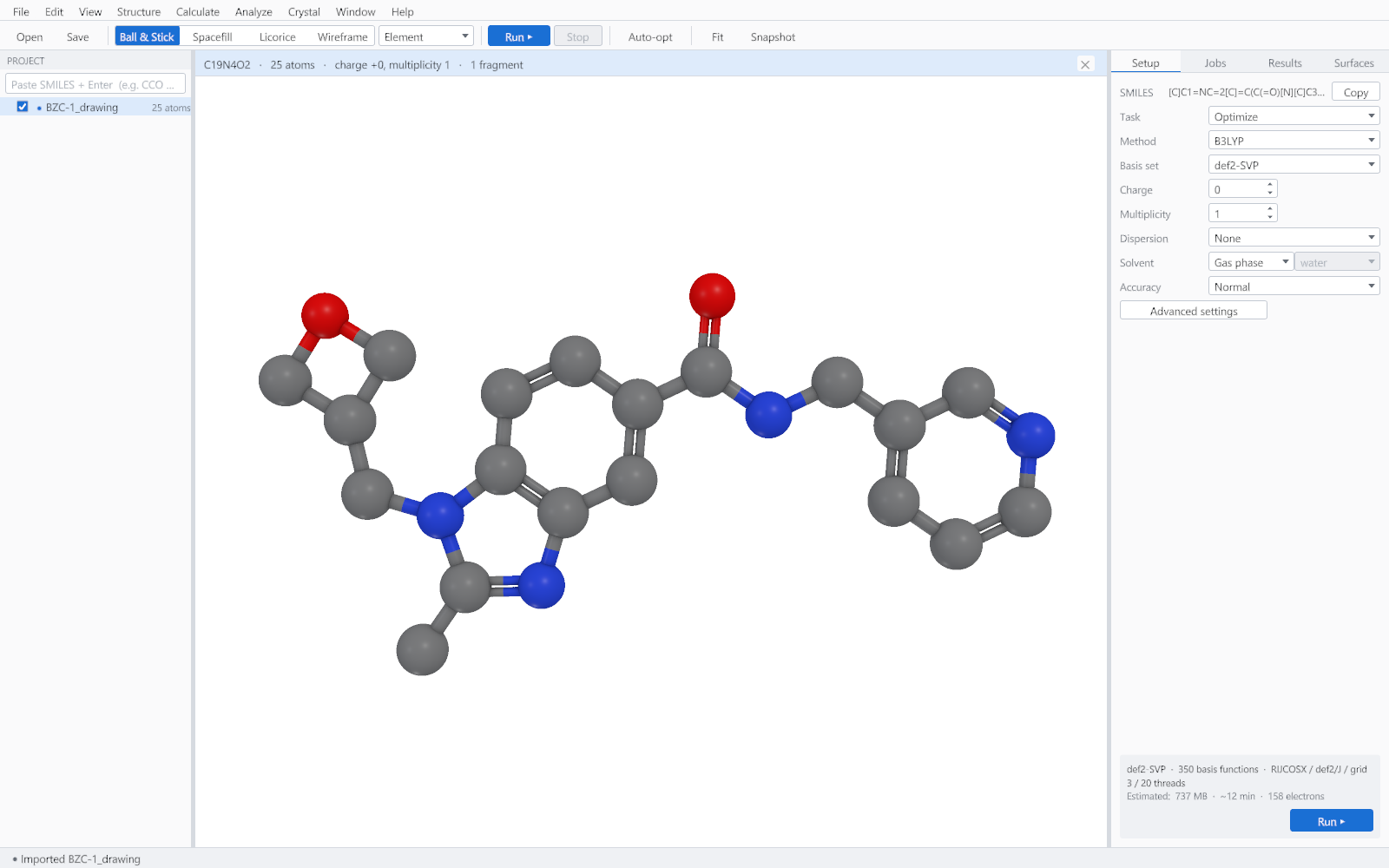
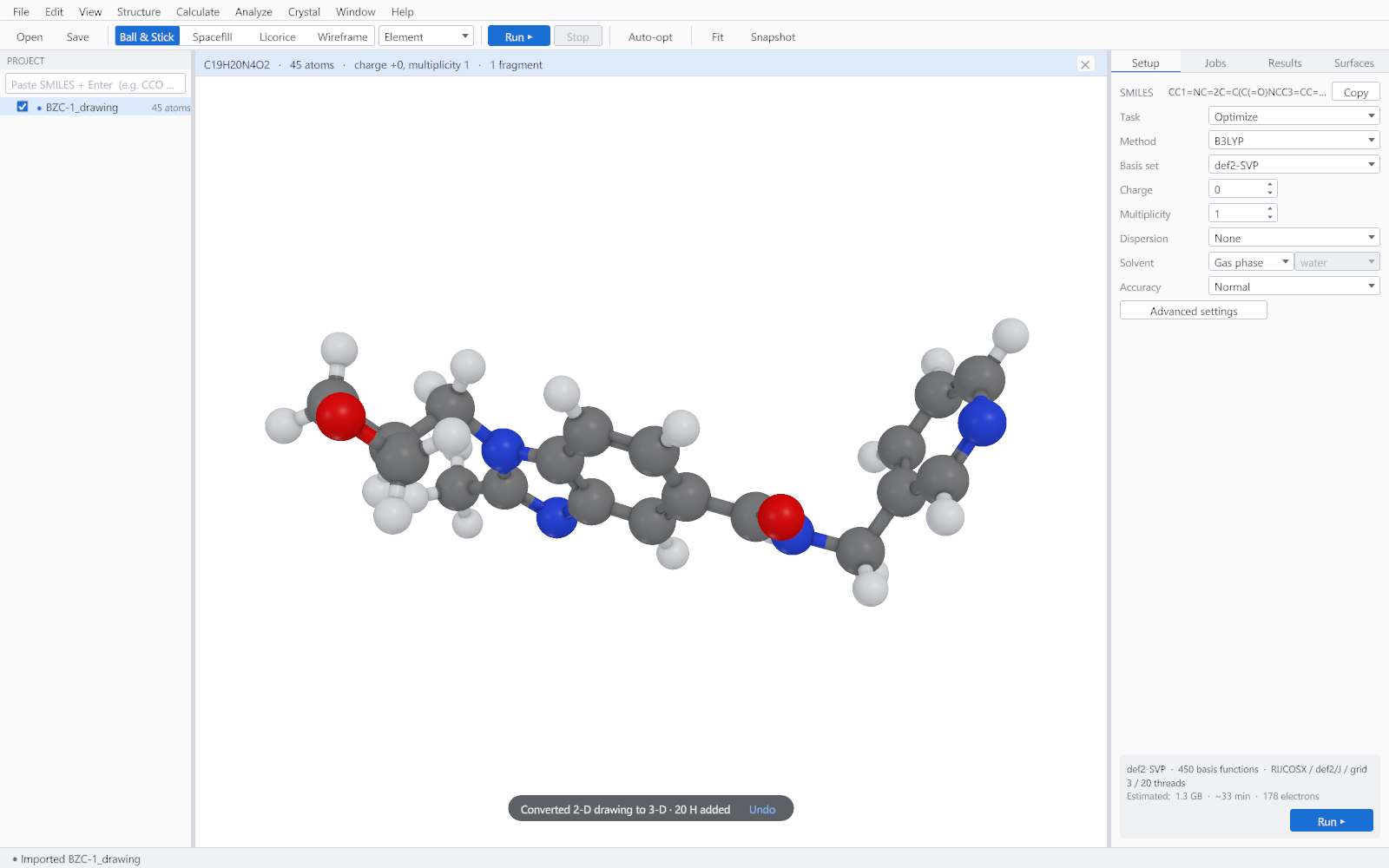
A two-dimensional drawing, the usual output of a sketching program, has every atom in one plane and often no hydrogens at all. Such a file is not a geometry, and a calculation run on it is meaningless. GeinDFT recognises the case and builds a real structure instead of refusing or, worse, proceeding.
- Missing hydrogens are added according to each atom valence, formal charge and bond orders.
- Three-dimensional coordinates are generated, keeping any stereochemistry the drawing carried in its wedge and hash bonds.
- The result is relaxed with the force field so bond lengths and angles are sensible.
Structures that are already three-dimensional
A planar molecule that already carries its hydrogens, benzene for example, is left exactly as it was read. The test is not flatness alone: a structure is rebuilt only when it is flat and missing hydrogens, or when an atom has an impossible number of neighbours, or when bond lengths are far from any chemically reasonable value.
What the program reports back
The bar above the viewer gives the molecular formula, the number of atoms, the charge and multiplicity that will be used, and the number of disconnected fragments. The fragment count is worth a glance: a structure that should be one molecule but reports two usually has a broken bond in the file.