Home › Properties and volumetric output
Properties and volumetric output
Choosing which properties are computed with the wavefunction, and which fields are written out for drawing afterwards.
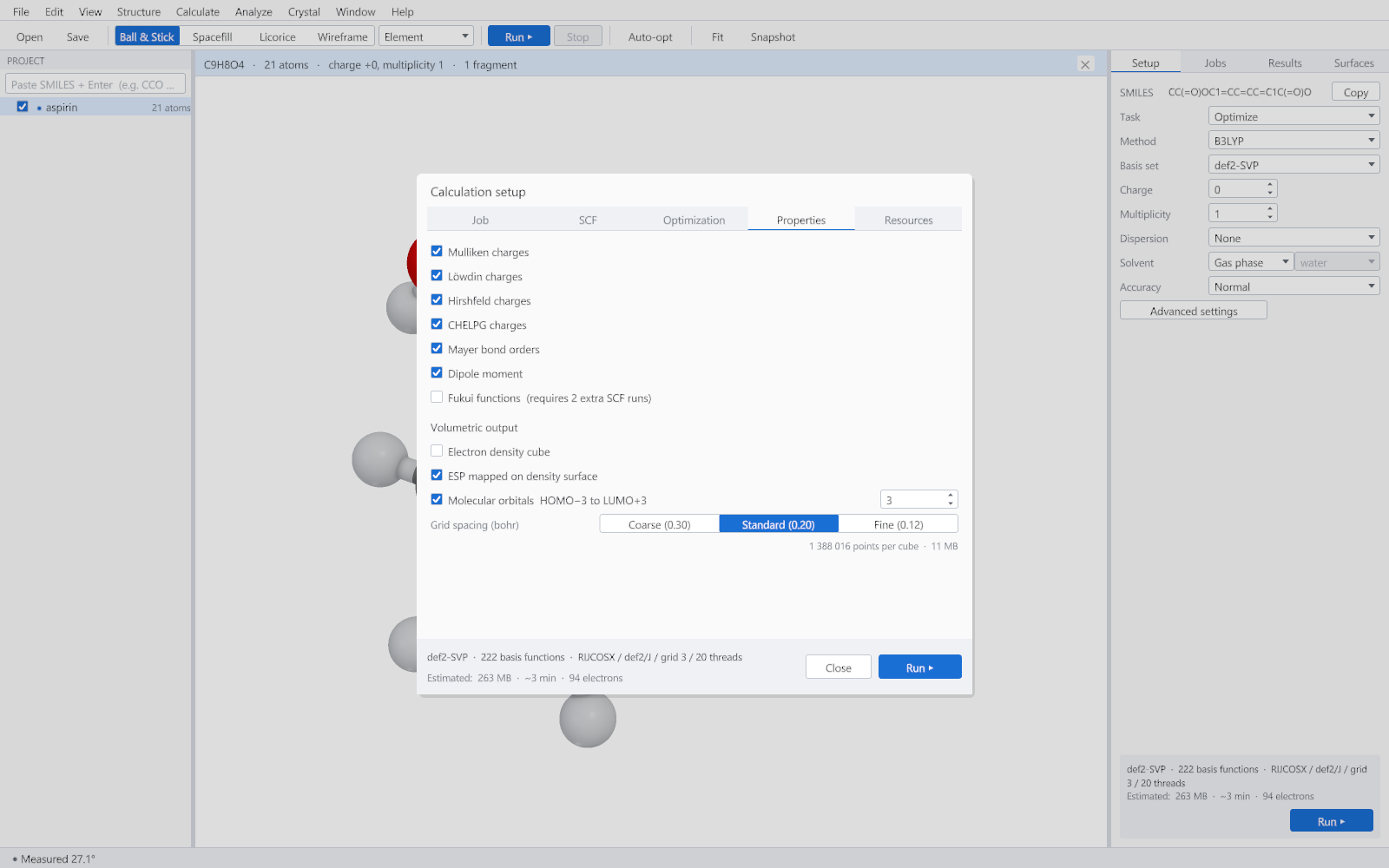
Properties
| Property | What it gives | Cost |
|---|---|---|
| Mulliken charges | The classical population analysis. Useful for trends within one molecule and one basis set; sensitive to the basis set, so not comparable across different ones. | Negligible |
| Loewdin charges | The same idea on symmetrically orthogonalised orbitals. Usually better behaved than Mulliken. | Negligible |
| Hirshfeld charges | Partitioning of the molecular density against a promolecule of free atoms. Small in magnitude, stable, and the right choice for comparing atoms across molecules. | Small |
| CHELPG charges | Charges fitted to reproduce the electrostatic potential around the molecule. The choice when the charges are to be used in a force field or to reason about electrostatics. | Small |
| Mayer bond orders | Bond orders from the density matrix: a number near one, two or three for a single, double or triple bond, and a fractional value for delocalised bonding. | Negligible |
| Dipole moment | The total dipole, reported in debye, and drawn in the viewer on request. | Negligible |
| Fukui functions | Where a molecule is susceptible to attack by a nucleophile, an electrophile or a radical. Needs the cation and the anion as well, so it runs two extra calculations. | Two extra SCF runs |
Volumetric output
| Field | What it is for |
|---|---|
| Electron density cube | The total density on a grid. The basis for a plain molecular surface, and the field other quantities are mapped onto. |
| ESP mapped on density surface | The electrostatic potential computed on the 0.001 electron per cubic bohr isosurface of the density. This is the standard way to show where a molecule is electron rich and electron poor. See Electrostatic potential surfaces. |
| Molecular orbitals | Cubes for a range of orbitals either side of the gap, set by the spinner. Three either side is usually enough to see the frontier chemistry. |
Grid spacing
The three settings trade detail against size and time. The dialog reports the point count and the size of each cube as you choose, so the cost is never a surprise.
| Setting | Spacing | Use |
|---|---|---|
| Coarse | 0.30 bohr | A quick look at the shape of an orbital. |
| Standard | 0.20 bohr | The default. Smooth enough for a figure in a paper. |
| Fine | 0.12 bohr | Close-up figures, and surfaces that will be printed large. |
The three-dimensional electrostatic potential over the whole box is a separate, much larger thing than the mapped surface, and it is not written unless it is asked for. The surface itself is computed analytically at the points of the mesh, which is both more accurate and far quicker than interpolating from a grid.