SCF and optimisation
The controls that decide how the self-consistent field converges, and how a geometry optimisation walks downhill.
The self-consistent field solves for the orbitals iteratively: each cycle builds a new potential from the current density and solves again, until the energy and the density stop changing. The defaults converge the overwhelming majority of closed-shell molecules without any attention, and the controls here exist for the cases that do not.
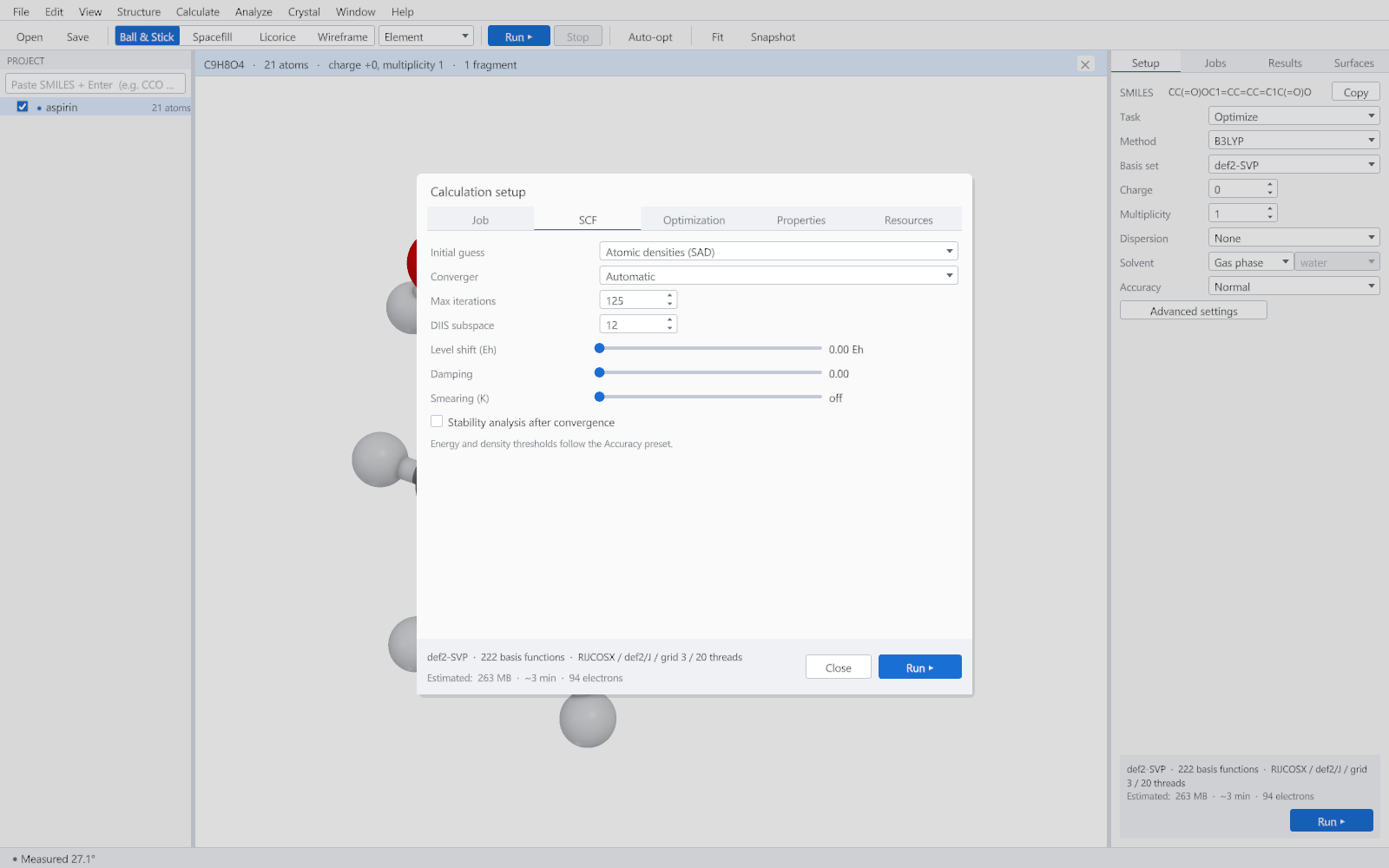
The SCF controls
| Control | Default | When to change it |
|---|---|---|
| Initial guess | Atomic densities (SAD) | SAD is the best general starting point. The alternatives matter mainly when comparing how different starts reach the same solution, which is a diagnostic rather than a production setting. |
| Converger | Automatic | Automatic picks a strategy and escalates if convergence stalls. Choose a specific one when you are investigating a difficult case and want the behaviour fixed. |
| Max iterations | 125 | Raise it for a system that is converging steadily but slowly. A calculation that is oscillating will not be rescued by more iterations; it needs a level shift or damping. |
| DIIS subspace | 12 | The number of previous iterations used to extrapolate. Smaller can help a system that oscillates; larger rarely helps. |
| Level shift | 0.00 Eh | Pushes the empty orbitals up in energy, which stabilises a system whose occupied and empty orbitals are close together. Try 0.2 to 0.4 hartree for a stubborn open-shell or transition-metal case. |
| Damping | 0.00 | Mixes in the previous density to stop wild swings in the first iterations. |
| Smearing | off | Fractional occupations at an electronic temperature. For systems with a vanishing gap. The energy it produces is not the ground-state energy of an integer-occupied system, so use it to get convergence, then confirm without it. |
| Stability analysis | off | After convergence, tests whether a lower solution exists with broken symmetry. Worth running for biradicals and for any result that looks too symmetric to be true. |
When the SCF will not converge
- Check the structure first. A badly distorted geometry, two atoms almost on top of each other or a wrong multiplicity cause more convergence failures than any numerical setting.
- Add a level shift of 0.2 to 0.4 hartree.
- Add damping.
- Start from a converged calculation on a smaller basis set.
The Optimization tab
A geometry optimisation moves the atoms downhill on the energy surface using the analytic forces, in internal coordinates: bonds, angles and torsions, which are the coordinates the molecule actually moves along. It stops when five separate criteria are met at once, so that neither a flat torsion nor a small step on its own can declare success.
| Criterion | What it tests |
|---|---|
| Energy change | The step changed the energy by less than the threshold. |
| Maximum force | No single atom is still being pushed appreciably. |
| Root-mean-square force | The forces as a whole have gone. |
| Maximum displacement | No atom moved far in the last step. |
| Root-mean-square displacement | The structure as a whole has stopped moving. |
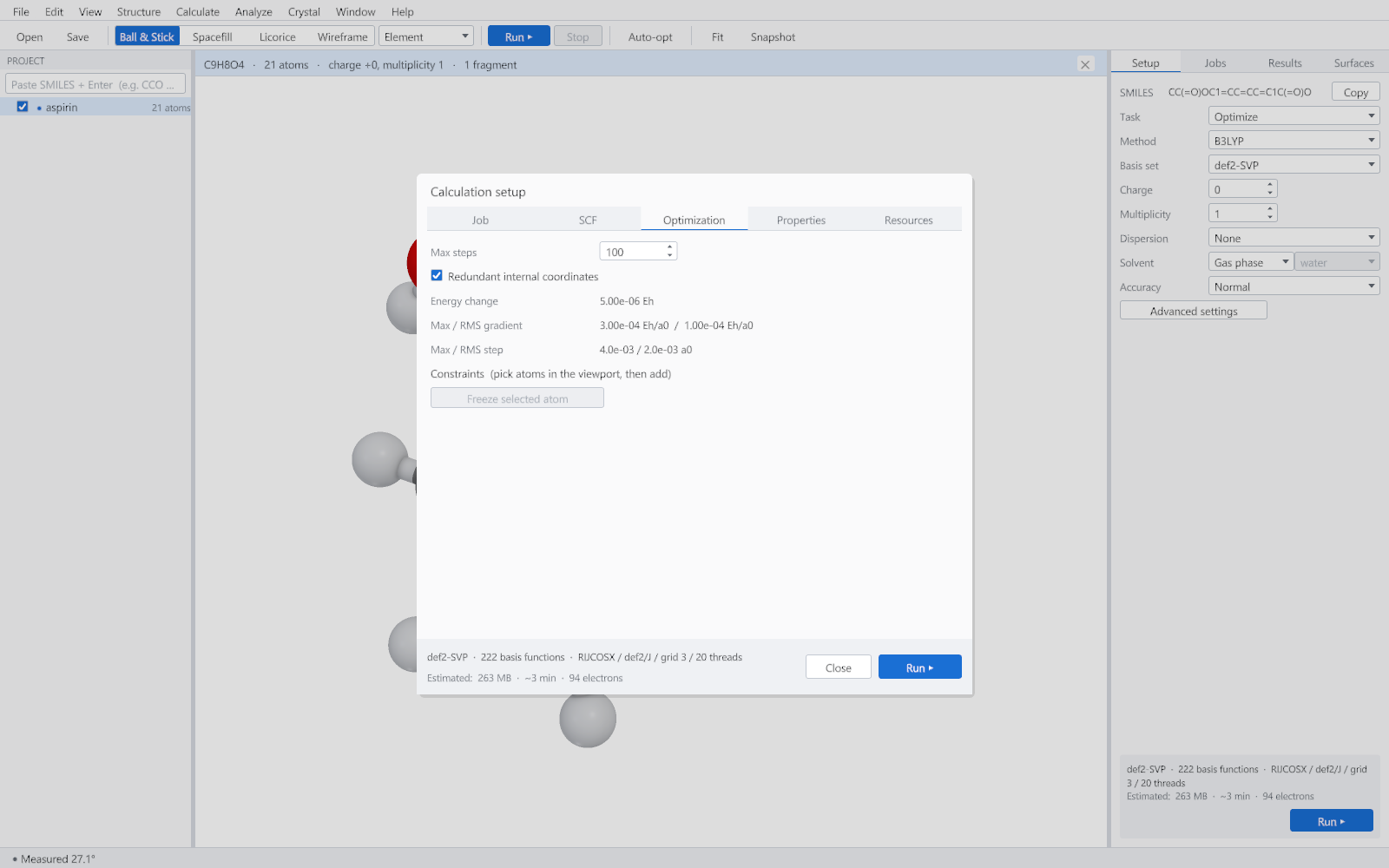
The tab also carries the step limit and lets the optimisation run in Cartesian coordinates instead, which is occasionally useful for a system whose connectivity confuses the internal coordinate generator.
--ts. A frequency calculation afterwards is not optional there: exactly one imaginary frequency is what makes the structure a transition state.