Charges and reactivity
The four charge schemes, when each is appropriate, and the descriptors derived from the frontier orbitals.
Four schemes, four answers
An atomic charge is not an observable: it depends on how the electron density is divided between atoms, and there is more than one defensible way to divide it. GeinDFT computes four, and they will not agree. The water molecule below is the clearest possible case.
| Scheme | Oxygen | Each hydrogen | What it is good for |
|---|---|---|---|
| Mulliken | -0.294 | +0.147 | Trends within one molecule at one basis set. Strongly basis-set dependent. |
| Loewdin | -0.150 | +0.075 | The same idea, better behaved, still basis-set dependent. |
| Hirshfeld | -0.309 | +0.155 | Comparing the same atom across different molecules. Small, stable values. |
| CHELPG | -0.707 | +0.353 | Anything electrostatic: force-field parameters, or reasoning about how a molecule interacts at a distance. |
The numbers are from water at B3LYP with a triple-zeta basis. They differ by a factor of more than four between schemes, which is the point: quote the scheme with the number, and never compare a charge from one scheme with a charge from another.
Charges in the picture
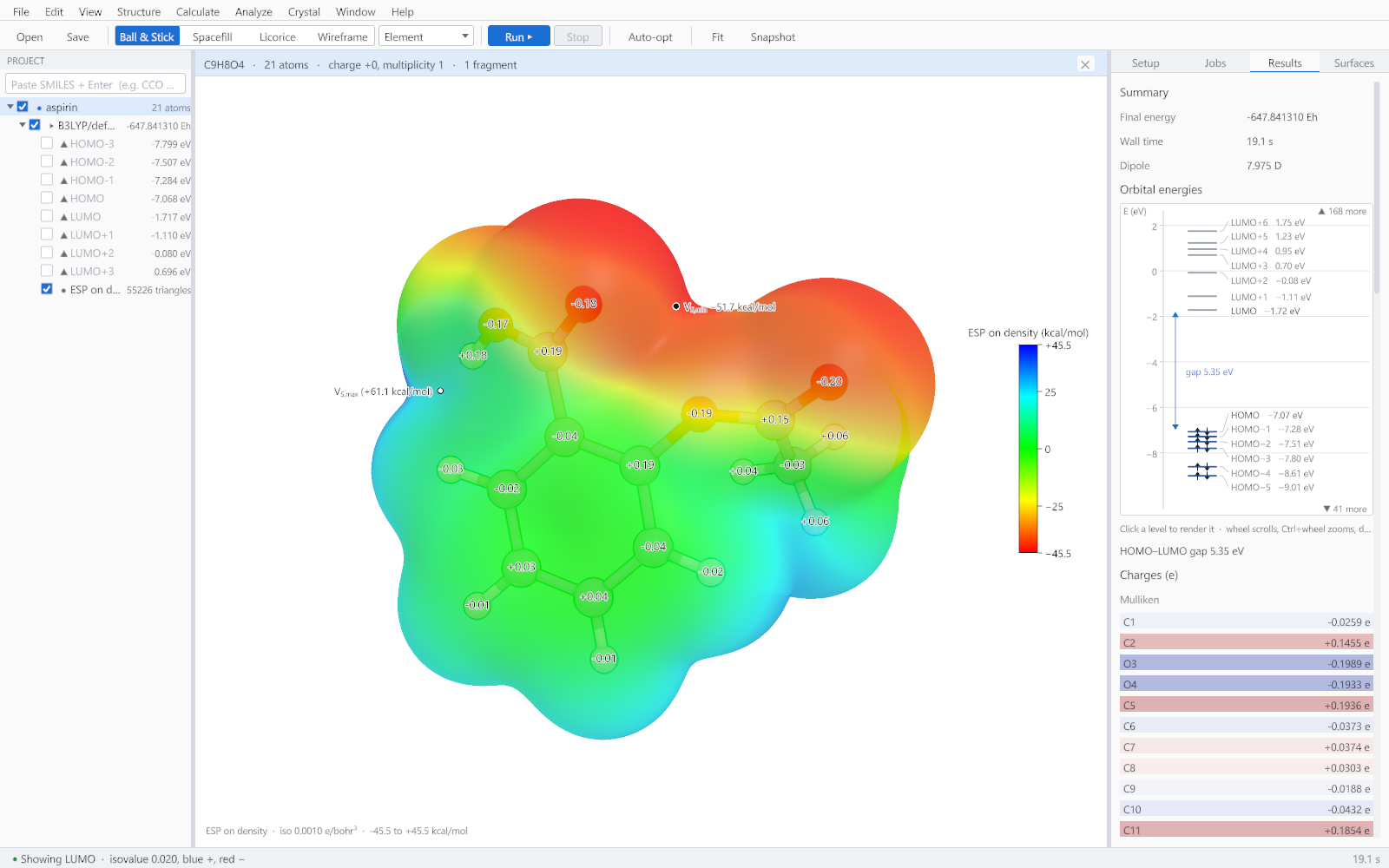
Analyze > Charge Labels (Q) labels the atoms. View > Colour by Charge colours them instead, with a diverging scale that puts neutral in the middle, which reads better for a large molecule.
Bond orders
Mayer bond orders come from the density matrix rather than from the drawn connectivity. A value near one, two or three is a single, double or triple bond; a value near one and a half across a ring is the delocalisation you would expect in an aromatic system. They are the honest way to ask what the calculation thinks the bonding is, rather than what the input file asserted.
Reactivity descriptors
| Descriptor | Definition used | Reading it |
|---|---|---|
| Ionisation potential | Minus the HOMO energy | How readily the molecule gives up an electron. |
| Electron affinity | Minus the LUMO energy | How readily it accepts one. |
| Chemical hardness | Half the HOMO to LUMO gap | Resistance to change in electron number. Large gap, hard molecule. |
| Electronegativity | Minus the average of the two frontier energies | The tendency to attract electrons overall. |
| Electrophilicity index | From electronegativity and hardness | A single number for how electrophilic a molecule is, useful for ranking a series. |
Fukui functions
Fukui functions answer where, not merely how much: they show which atoms carry the density that responds when an electron is added or removed, and therefore where a nucleophile or an electrophile will attack. They need the cation and the anion as well as the neutral molecule, so they cost two extra calculations and are off by default.